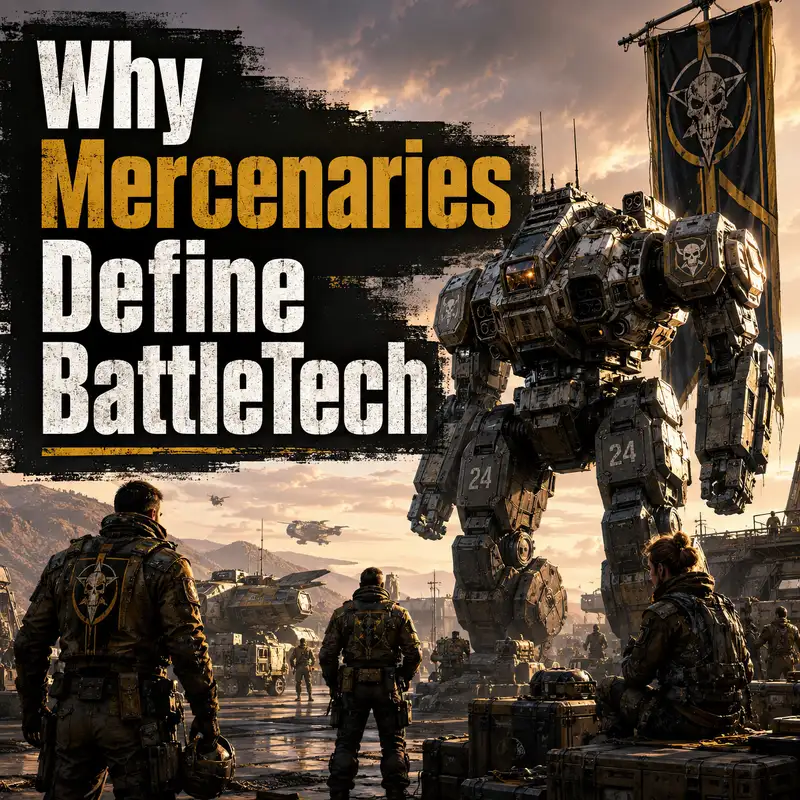
Why Mercenaries Define BattleTech
The mercenary company had won the battle. Its employer still had several ways to destroy it. The contract might deny reimbursement for damaged BattleMechs. The salvage clause might award the best wrecks to the government troops that arrived after the firing stopped. The promised DropShips might suddenly be unavailable. Payment might be delayed until a review board decided whether the company had technically completed an objective that no longer existed. Victory, in other words, had solved the immediate military problem. It had not settled the account.
That contradiction explains why mercenaries define BattleTech. They stand at the point where battlefield courage meets political convenience, where inherited war machines meet maintenance bills, and where loyalty is tested by language written before anyone knew what the campaign would become. A House regiment can lose a battle and remain part of a state. A mercenary command can win and disappear because it cannot replace three actuators, pay its technicians, or purchase passage to the next system. Mercenaries make warfare personal, uncertain, and expensive.
Hired soldiers existed long before humanity reached the stars, but interstellar politics gave the profession new life. During the Age of War, distant worlds and rising states needed trained troops faster than they could build reliable national institutions. The Star League reduced that demand by imposing a powerful central order, though mercenaries still served as auxiliaries and deniable instruments during the hidden conflicts among the Great Houses. Then the Amaris Civil War shattered the League, and Aleksandr Kerensky departed with most of the surviving Star League Defense Force in the year twenty-seven eighty-four.
The soldiers left behind faced a divided Human Sphere and no central government worth serving. Many entered the militaries of the Successor States. Others possessed training, equipment, and unit identities that rulers wanted, but they did not wish to surrender those assets permanently to a single dynasty. They hired themselves out. When the First Succession War began, the Great Houses had enormous ambitions, damaged institutions, and far more territory than their regular armies could protect. Mercenary service moved from the margins of war into its daily machinery.
The reason was not that the Successor Lords trusted mercenaries. They usually trusted them less than their own troops, often with good cause. The reason was that they needed them. A border hundreds of light-years long could not be covered by elite House regiments alone. Planetary nobles needed garrisons. Trade routes needed protection from pirates. Intelligence agencies needed forces whose uniforms did not point directly toward a capital. Field commanders needed experienced reserves, instructors, raiders, scouts, and sometimes a formation that could be sacrificed without producing a domestic political crisis.
Mercenaries also gave governments flexibility. A regiment could be hired for one campaign, shifted across a border, or released when the treasury tightened. That was attractive to rulers who wanted military power without the permanent cost of recruiting, training, transporting, and pensioning another regular formation. A raid against a nominally friendly state, support for a disputed claimant, or suppression of a local revolt could be described as the work of unruly contractors if the operation failed. Plausible deniability is often another name for assigning the consequences to someone with a smaller flag.
That arrangement never made mercenaries truly independent. Their freedom existed inside a web of dependence. They needed an employer’s money, access to supply depots, replacement ammunition, medical facilities, intelligence, and often transportation. A commander who refused an unlawful order might preserve the unit’s honor and lose the contract. A commander who accepted every mission might remain solvent while destroying the reputation needed to secure future work. The profession offered choice, but every choice came with a price quoted in C-bills, casualties, or both.
The contract therefore became a weapon as consequential as any particle projection cannon. It defined the mission, duration, payment, command relationships, support obligations, transport, resupply, battle-loss compensation, and salvage. It could establish whether the employer controlled operational planning or merely set objectives. It could require a unit to remain on a world after the original campaign had changed. It could promise bonuses for captured equipment and impose penalties for withdrawal. The best contracts described what both parties owed. The worst described what the mercenaries owed and left the employer’s responsibilities to patriotic interpretation.
Salvage was never simply treasure scattered across a battlefield. For a mercenary command, it was the replacement system. A disabled enemy BattleMech might provide the engine component needed to restore one machine, the armor plate needed to patch another, and weapons that could be sold to cover payroll. Recovery vehicles, technicians, security troops, and time were all required before a wreck became useful. The side that held the field could still lose the salvage if it lacked transport or if the contract assigned ownership elsewhere. A ruined BattleMech had value, but only after someone survived long enough to drag it home.
The famous machines receive the attention, yet the decisive personnel are often standing beside them with diagnostic tools and account ledgers. A sustainable mercenary force needs technicians, assistant technicians, medics, administrators, intelligence specialists, negotiators, and supply personnel. It needs infantry to secure landing zones, vehicles to carry fuel and ammunition, scouts to locate the enemy, and recovery crews to retrieve damaged equipment. A commander who recruits MechWarriors but neglects maintenance staff has not created a military unit. The commander has organized a brief exhibition followed by an auction.
Transport is the dividing line between a mobile command and an armed hostage. Owning enough DropShips to carry the force allows a mercenary commander to assault a planet, reposition during a campaign, and leave when an employer’s promises become unreliable. JumpShips are rarer and more expensive, so even successful commands often depend on chartered interstellar passage. Every jump consumes time and money before the unit earns anything. A contract on the far side of the Inner Sphere may look generous until the commander calculates transit costs, missed opportunities, and the cheerful optimism of the person who estimated the travel schedule.
Because formal power was limited, reputation became the profession’s real currency. Employers needed to know whether a unit would fight, obey agreed rules, protect civilians, and remain in place when the situation deteriorated. Mercenaries needed to know whether an employer paid on time, honored salvage terms, and provided promised support. A commander could survive one bad battle. Recovering from a reputation for desertion, atrocities, or broken contracts was harder. Names such as the Kell Hounds, the Eridani Light Horse, and Wolf’s Dragoons carried military value before deployment because allies and enemies had expectations about how they would behave.
The Mercenary Review Board emerged because reputation alone was not enough. ComStar established the board in the year twenty-seven eighty-nine as a broker and arbitrator between employers and mercenary commands. It registered units, recorded contracts, evaluated performance, and offered a forum for disputes. Publicly, this reduced some of the danger in an inherently suspicious business. Privately, it also gave ComStar an excellent position from which to observe the movement, strength, and employment of armed formations across the Inner Sphere. Neutral institutions in BattleTech often perform useful work while keeping a second ledger.
Galatea became the great hiring center of the Succession Wars. Mercenaries could rest, recruit, train, repair equipment, meet employers, and discover how rapidly savings disappeared when an entire planet specialized in selling services to unemployed soldiers. Wolf’s Dragoons later developed Outreach as a competing center, opening a hiring hall there in the year thirty thirty-two and adding training and technical support. After ComStar lost its claim to neutrality during the Clan Invasion, the old board gave way to the Mercenary Review and Bonding Commission. The institution changed because the market could not function for long without some accepted referee.
This infrastructure reveals the scale of the profession. Mercenaries were not a few colorful bands wandering between major wars. They formed a labor market, a transportation market, a repair economy, an intelligence network, and a political constituency. Hiring halls connected veterans, dispossessed MechWarriors, technicians, recruiters, lenders, transport captains, manufacturers, and governments. A failed campaign could create new job seekers, while a successful offensive could flood the market with salvage. A new war raised contract prices while increasing the chance that the contractor would not live to collect them.
On campaign, mercenaries filled nearly every military role. Some guarded quiet worlds so regular formations could concentrate elsewhere. Some hunted pirates, trained militias, escorted convoys, or protected industrial sites. Others conducted reconnaissance, raids, planetary assaults, counterinsurgency, and long defensive campaigns. The best commands developed specialized skills and coherent doctrine. The worst were armed crowds with impressive stationery. Most existed between those extremes, capable of disciplined service when properly led and supported, yet vulnerable to the same fatigue, fear, factionalism, and poor judgment found in every other human institution.
Their use also carried serious risks. Employers sometimes selected mercenaries because they were willing to perform missions regular troops might reject. Some commands committed atrocities, changed sides, abandoned civilians, or treated occupied worlds as sources of loot. Governments then condemned the entire profession while continuing to hire it. Other commands were framed for an employer’s crimes or sent into impossible battles so a ruler could avoid losing politically valuable troops. Understanding mercenaries requires holding both facts at once. Contract soldiers could be predators, victims, professionals, or all three during different stages of the same career.
The long Succession Wars even encouraged mercenary practices that helped limit some fighting. As technology and trained personnel became harder to replace, commanders had reasons to accept surrender, ransom captured MechWarriors, and recover equipment rather than annihilate every opponent. These customs did not make the wars humane. Worlds were still devastated, civilians still suffered, and rulers still ignored restraint when ambition demanded it. Yet the practical need to preserve scarce machines and experienced crews sometimes imposed limits that moral appeals had failed to maintain. Civilization survived in part because even war had become too expensive to conduct without rules.
Mercenary formations also look like the setting itself. Their equipment is mixed, inherited, repaired, captured, purchased secondhand, and modified according to whatever parts are available. A lance may contain BattleMechs associated with several different states because the unit has crossed borders, changed employers, absorbed survivors, and rebuilt from salvage. Its personnel may include former House soldiers, planetary militia veterans, dispossessed nobles, Periphery recruits, and technicians who care less about heraldry than whether the replacement coolant line fits. The result is not disorder by definition. It is adaptation made visible.
The Eridani Light Horse represented one path through that world. Descended from the Star League Defense Force, the unit carried old institutional traditions into centuries when the League itself no longer existed. Mercenary status allowed it to survive without surrendering its identity completely to a Successor State. Its service showed that a hired command could preserve professional standards and historical memory across changing employers. The Light Horse fought for money because money sustained the unit, but its reputation rested on the belief that there were obligations older than the current contract.
The Northwind Highlanders and McCarron’s Armored Cavalry demonstrate two different forms of loyalty. The Highlanders served House Liao for generations, then changed sides during the Fourth Succession War when House Davion offered the return of their ancestral world, Northwind. The decision was contractual, political, and deeply cultural at the same time. McCarron’s Armored Cavalry moved in the opposite direction, becoming so closely tied to the Capellan Confederation that the distinction between favored mercenaries and national troops eventually narrowed to almost nothing. A mercenary relationship could be temporary, hereditary, transactional, patriotic, or all of those in succession.
Wolf’s Dragoons provide the most revealing example. The Clans needed a force that could travel throughout the Inner Sphere, serve different governments, study their militaries, and explain unusual equipment and organization without immediately appearing to be an invading army. A mercenary identity solved that problem. The Dragoons could arrive with five regiments, negotiate contracts across the Successor States, and move from one realm to another because the Inner Sphere already possessed a mature culture of hired military service. Their disguise worked because mercenaries were expected to come from somewhere else and to carry complicated histories.
The disguise did not remain a disguise. Repeated service, betrayal, friendship, and bloodshed bound the Dragoons to the societies they had been sent to observe. They became political actors, military advisers, employers, trainers, and eventually defenders of the Inner Sphere against the Clan invasion. Outreach became a center of the entire mercenary trade because the Dragoons had acquired enough authority to shape the profession that once concealed them. Their history captures a central BattleTech theme: institutions change the people who use them, even when those people believe they are merely exploiting the institution.
The defense of Luthien in the year thirty fifty-two exposed that transformation with unusual clarity. The Draconis Combine had once pursued Wolf’s Dragoons under Takashi Kurita’s Death to Mercenaries policy. Yet when Clan Smoke Jaguar and Clan Nova Cat threatened the Combine capital, Wolf’s Dragoons and the Kell Hounds joined its defense. They fought beside troops of a state that had treated mercenaries as enemies and helped prevent the fall of Luthien. The battlefield did not erase old hatred, but strategic necessity forced political leaders to recognize that reliability could exist outside formal allegiance.
The Gray Death Legion demonstrates a different kind of importance. It began as a small force assembled from disaster, personal loyalty, captured equipment, and the determination to remain alive. Its growth into a respected combined-arms command made it a model of the mercenary story, but its greatest effect came from something larger than a contract. On Helm in the year thirty twenty-eight, the Legion recovered a Star League memory core and helped distribute its knowledge. A private military unit, operating amid betrayal and salvage, became one of the agents of the Inner Sphere’s technological recovery.
That choice matters because it rejects the simplest interpretation of mercenary motivation. The Legion could have treated the memory core as exclusive property, sold it to the highest bidder, or allowed one government to control it. Instead, the knowledge spread. This did not transform every mercenary into a public servant, and it did not make the Legion free from ambition or error. It showed that people who fight for pay can still act from loyalty, principle, revenge, fear, generosity, and a sense of historical responsibility. A contract describes employment. It does not fully describe a human being.
Mercenaries also define how BattleTech tells stories. The first BattleTech novel, Decision at Thunder Rift, followed the events that created the Gray Death Legion. That was an effective viewpoint because a mercenary command can move across borders without making one Great House the permanent moral center of the setting. Its members can serve a government, witness its virtues and abuses, then encounter the same contradictions elsewhere. They are close enough to power to influence wars, but rarely secure enough to mistake power for permanence.
The same structure makes mercenary campaigns natural for players. A self-created command can recruit people from different backgrounds, field machines acquired through salvage, accept work from rival states, and carry the consequences of one battle into the next. The unit’s history is more than a record of victories. It is the Atlas that cannot be repaired, the veteran technician killed during an evacuation, the contract refused on principle, the loan accepted in desperation, and the employer who remembers an old betrayal. Mercenary play turns separate battles into an institutional biography.
That continuity changes the meaning of combat. In an isolated engagement, losing armor is temporary and ammunition is an accounting detail. In a mercenary campaign, damage has a future. Every destroyed weapon affects the next deployment. Every wounded pilot creates a gap in the roster. Every captured BattleMech creates both an opportunity and a repair problem. The commander must decide when continued fighting will cost more than the objective is worth. Tactical aggression becomes inseparable from operational endurance.
It also changes leadership. A mercenary commander is simultaneously a battlefield officer, employer, diplomat, quartermaster, recruiter, and small-state politician. The commander decides who gets the functioning BattleMech, which families receive death benefits, whether a questionable mission is acceptable, and how much truth to tell troops about the unit’s finances. Charisma may assemble a company, but administration keeps it alive. The romantic image is a MechWarrior standing in a command cockpit. The durable reality is someone reviewing repair estimates while negotiating with a transport captain who has already heard about the late payment.
This is why mercenaries keep BattleTech morally unsettled. Service for pay can enable exploitation, but service to a flag can enable the same crimes with better uniforms. Mercenary characters cannot rely entirely on patriotism to justify their choices. They must ask what the employer wants, what the contract permits, what the mission will do to civilians, and what refusal will do to their own people. They may choose honor and suffer for it. They may choose survival and discover that survival has altered who they are.
The Great Houses shape history on the largest scale, but mercenaries reveal how that history functions at ground level. Dynastic strategy becomes a landing schedule. Territorial ambition becomes a garrison contract on a world whose people did not request new rulers. Industrial decline becomes a technician machining a substitute part because the original factory was destroyed two centuries earlier. Political betrayal becomes a DropShip lifting without the unit it was supposed to evacuate. Mercenaries translate the map of the Human Sphere into decisions that individual people must make.
They define BattleTech because they embody its central contradictions. They are independent and dependent, mobile and trapped, professional and improvised, feared and necessary. Their BattleMechs are symbols of power that may be one missed payment away from repossession or one broken component away from becoming salvage. Their contracts promise order in a political system built on rivalry, distance, and incomplete information. Their reputations can outlast governments, yet a single disastrous campaign can erase generations of work.
A mercenary command therefore offers the clearest view of the setting. Follow its contract and the Great Houses appear with their ambitions exposed. Follow its supply chain and the limits of technology become visible. Follow its casualties and the human cost of interstellar politics stops being an abstraction. Follow its salvage crews after the battle and victory becomes something that must be repaired, transported, financed, and explained. Mercenaries define BattleTech because they show that war is never only about who holds the field. It is about who can afford to leave it, rebuild, and still recognize the unit that returns.