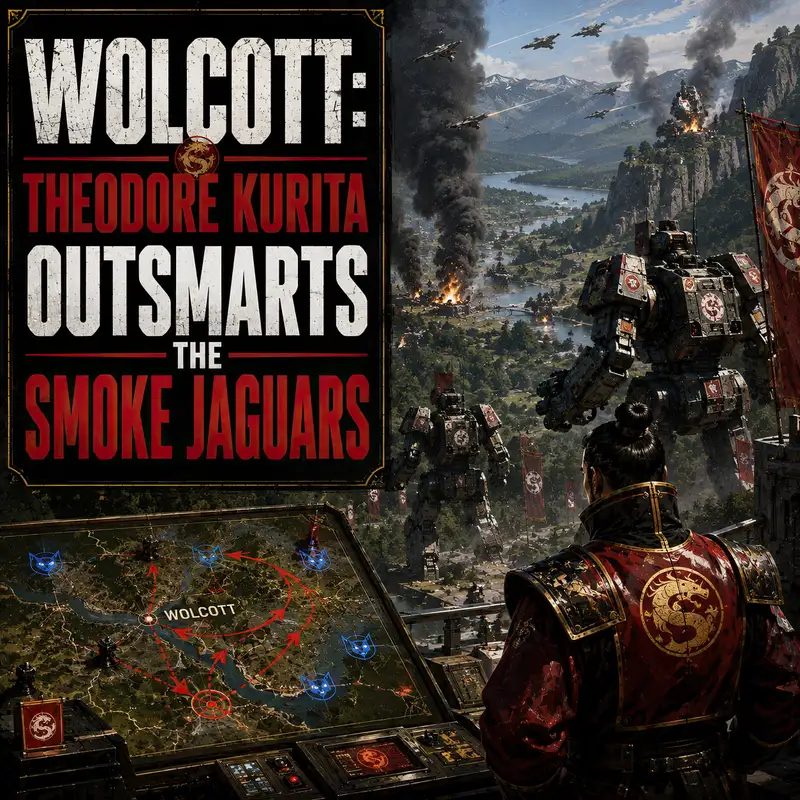
Wolcott: Theodore Kurita Outsmarts the Smoke Jaguars
The decisive weapon at Wolcott was a set of false personnel files. Theodore Kurita created two regiments that did not exist, gave them a history of inexperience, and arranged for Clan Smoke Jaguar to learn exactly what he wanted them to know. He placed his own son on the planet, selected a battlefield of hot marshes and heavy fog, and waited for the Jaguars to issue a challenge. By the time their DropShips descended, the battle had already been shaped around their confidence. The Jaguars believed they were choosing an easy conquest. Theodore had chosen the enemy, the ground, the terms, and the assumptions they would bring with them.
By October of the year thirty fifty, the Draconis Combine needed more than another delaying action. Clan Smoke Jaguar had torn through frontier defenses with OmniMechs, Elemental battle armor, aerospace superiority, and a command culture that treated resistance as proof of inferiority. Worlds had fallen before neighboring systems received reliable warnings. The destruction of Edo on Turtle Bay had shown what Jaguar occupation could become when battlefield victory failed to produce obedience. Theodore, serving as Gunji-no-Kanrei under his father, Coordinator Takashi Kurita, understood that his realm needed a victory that could be measured, studied, and repeated.
Theodore had spent much of his career challenging the Combine’s worst military habits. Traditional doctrine often rewarded direct attack, personal sacrifice, and obedience to forms of honor even when those forms wasted experienced officers and irreplaceable machines. Theodore did not reject duty or courage. He rejected the assumption that courage excused poor planning. During the War of thirty thirty-nine, he had used deception, maneuver, and the appearance of strength to halt a larger Federated Commonwealth offensive. Against the Clans, he again looked for a way to make the enemy act on a false picture.
Turtle Bay provided the human sources he needed. His son Hohiro had fought there, been captured by the Smoke Jaguars, and escaped with the help of Shin Yodama and local yakuza networks. Hohiro had seen the Clan batchall, the power of their machines, and the anger that followed irregular resistance. Shin understood the occupation from the streets and tunnels rather than the command post. Together, they knew that the Jaguars were disciplined warriors operating inside a system whose rules could be anticipated, encouraged, and turned against them.
Theodore’s plan did not depend on the Jaguars forgetting how to fight. It depended on them believing that their institutions guaranteed the meaning of what they saw. Clan bidding encouraged commanders to defeat an opponent with the smallest force necessary. Zellbrigen favored controlled engagements between warriors. Victory created a claim to the objective, while surrender and captured matériel could be governed by agreed terms. Prestige came from winning under those restrictions. A commander who appeared cautious against a weak opponent risked looking less honorable than one who accepted the challenge.
In July, Theodore gathered senior officers on Marshdale and presented Operation Sakkaku. The plan would offer one carefully prepared world as bait and create a battle whose consequences exceeded the planet’s immediate value. Wolcott was close enough to the advancing front to attract attack, and its terrain could neutralize several Clan advantages. If the Combine held it, the world could also become a secure position inside the growing occupation zone. Wolcott would be both battlefield and future base.
The chosen ground lay on the eastern continent in a place known as Swamp Valley. Dense trees rose from hot, shallow marshes. Fog limited visibility. Soft ground restricted movement and concealed sudden changes in depth. Clan weapons still possessed greater range, but range matters only when a target can be detected and engaged before it disappears. The terrain would shorten sight lines, interfere with sensors, channel movement, and complicate coordination between OmniMechs and Elementals. Theodore was not trying to make Clan technology disappear. He was forcing it to solve the wrong kind of problem.
The defenders improved the terrain with the care of engineers given time and a grudge. Metallic strips hung through the trees to create false returns. Tiger pits were concealed beneath the marsh and seeded with vibrabombs. Routes were surveyed for hovercraft that could move where heavier machines would struggle. Camouflage matched the wet forest, and BattleMechs were prepared to conceal their heat signatures while standing in water. Each measure was modest. Together, they created an environment in which the Jaguars could not trust their instruments.
Theodore then hid the identity of the defending force. The First and Second Genyosha were among the most capable BattleMech regiments in the Draconis Combine Mustered Soldiery. They represented his reform program: disciplined, flexible, and loyal to a version of duty that valued the mission over theatrical sacrifice. For Wolcott, the Genyosha disappeared from the official picture. Their personnel and machines were reassigned on paper to newly created Yuutsu regiments, supposedly green formations with no serious combat record. False dossiers, unit histories, and readiness reports completed the deception.
The bait was personal. Theodore ensured that the Jaguars learned Hohiro Kurita and Shin Yodama were on Wolcott. Both had escaped Jaguar control at Turtle Bay. Their presence promised the recovery of a valuable prisoner and revenge against the man who had helped free him. It also made the story of weak defenders more believable. The Combine appeared to be protecting the heir with newly formed troops on a world that could be taken through a clean Trial. In reality, Hohiro and Shin were active participants in the trap.
The risk was considerable. Theodore was placing his son, two elite regiments, and a useful world within reach of a force that had destroyed every Combine formation it had met in open battle. If the deception failed, the Jaguars could reinforce, change the landing zone, or refuse the prepared ground. If the Genyosha were identified before the batchall, the Clan commander could bid a larger force. Defeat would cost the Combine much of the military elite Theodore had spent years building. Operation Sakkaku was careful. It was not safe.
Clan Smoke Jaguar arrived on the second of October under Galaxy Commander Dietr Osis. Osis had replaced Cordera Perez after the destruction of Edo, gaining command of Beta Galaxy through the Clan system of challenge. He brought the Two Hundred Twenty-fifth Jaguar Battle Cluster for the assault, with command and transport elements. The Jaguars had little reason to regard Wolcott as a major obstacle. Their intelligence described inexperienced troops, and their campaign record suggested that even veteran Inner Sphere units could be broken quickly.
Osis issued the expected batchall. Hohiro answered as the supreme commander of the forces on Wolcott and named Swamp Valley as the battlefield. He then offered terms unusually favorable to the defender. If the Jaguars won, Wolcott would belong to them. If the Combine won, Clan Smoke Jaguar would surrender four operational OmniMechs, provide two dozen suits of Elemental battle armor, and swear never to attack Wolcott again. Osis initially hesitated. Hohiro responded by emphasizing that the Clan commander faced only green troops and by implying that reluctance suggested fear.
The provocation was subtle because it did not ask Osis to behave irrationally. It asked him to behave consistently. The Jaguars believed they were superior in training, technology, and courage. Their own intelligence said the defenders were inexperienced. Their honor system accepted negotiated stakes, and refusal could damage Osis’s standing after he had already taken command from a disgraced predecessor. Hohiro did not force him to accept. He constructed a choice in which acceptance looked like confidence and caution looked like weakness. Osis agreed to the terms and committed his force.
The Jaguar DropShips entered Swamp Valley and hovered just above the uncertain ground while OmniMechs and Elementals deployed. From the landing zone, the valley appeared empty. No BattleMech line waited in the open. No artillery announced its location. The absence reinforced the intelligence picture. Green defenders might be hiding, disorganized, or unwilling to face the Clan force directly. The Jaguars spread out to form a perimeter and search for targets. They were already inside the area Theodore had prepared.
The Genyosha reduced their thermal signatures by shutting down systems and relying only on heat sinks submerged below the waterline. Camouflage and fog concealed their outlines, while metallic streamers distorted sensor returns. The technique imposed risk. A BattleMech operating with reduced systems could not respond instantly at full performance. The defenders accepted that vulnerability because concealment was more valuable than the first shot from an exposed position. They were waiting for the Jaguars to form the shape the ambush required.
The first visible attackers were not BattleMechs. Fast Savannah Master hovercraft burst from concealment, struck at the Jaguar perimeter, and withdrew before the heavier OmniMechs could bring their weapons to bear effectively. The vehicles could not destroy the Clan formation by themselves. Their purpose was to provoke movement, draw attention, and make the Jaguars close ranks against repeated attacks from uncertain directions. Every turn toward a hovercraft was a turn away from another threat. Every attempt to form a tighter perimeter reduced the space available for individual warriors to maneuver.
Heavier Drillson and Saracen hovertanks followed. Their weapons struck from the marsh channels while long-range missiles fell from Genyosha heavy BattleMechs hidden farther back. The Jaguars had expected superior range to let them control the engagement. Instead, they received fire from targets obscured by fog, trees, sensor clutter, and water. The Combine units fired, displaced, and vanished into the prepared terrain. Clan warriors seeking individual opponents found an enemy that presented vehicles, missile salvos, and brief BattleMech contacts rather than a stable line of duels.
Light Genyosha BattleMechs used their mobility for repeated hit-and-run attacks. They appeared on a flank, concentrated fire, and withdrew before the Jaguars could reorganize. When Clan units pursued, pits, mines, and soft ground disrupted their movement. When they remained together, missiles and heavier hovercraft punished the concentration. The defenders did not defeat one OmniMech at a time according to Clan custom. They attacked the formation as a system, forcing every Jaguar response to create another vulnerability.
The fog also degraded command and control. Better sensors still depend on coherent information. False returns, intermittent contacts, and units moving through trees made it difficult to distinguish a real attack from another feint. Elementals found fewer clean approaches against hovercraft that refused close combat. Aerospace and orbital advantages mattered less beneath heavy weather and dense cover, with friendly units mixed into the same area. Theodore had selected a place where the most expensive capabilities could not be applied cleanly.
The Combine force, by contrast, had rehearsed the ground. Drivers knew which channels could support speed. Missile units knew the reference points for indirect fire. MechWarriors knew where they could disappear from sensors and where a pursuing machine might sink, stumble, or trigger a mine. Engineers had converted terrain knowledge into combat power. This was combined-arms warfare in its least glamorous and most useful form. The BattleMechs delivered the decisive weight, but hovercraft, mines, camouflage, reconnaissance, and preparation made that weight effective.
For several hours, Osis tried to regain control. His warriors remained individually dangerous, and any Genyosha unit that stayed exposed risked destruction. Yet the Jaguars could not force the defenders into the open battle their weapons favored. OmniMechs were destroyed or crippled, and others lost mobility in the marsh. The Clan formation became progressively less able to protect itself against attacks from several directions. Osis eventually recognized that continued fighting would consume his force without producing the objective. He called for the battle to stop and acknowledged defeat.
The decision to surrender was not cowardice. It was the most rational command choice Osis made on Wolcott. The agreed Trial had been lost, the terrain remained under enemy control, and further casualties would not alter the political terms. Clan law and custom gave him a mechanism to preserve surviving warriors. The same system that had helped lure him into the battle now required him to honor its outcome. Hohiro accepted the surrender and allowed the remaining Jaguars to withdraw after the promised transfer of equipment.
Four OmniMechs and twenty-four Elemental suits passed into Combine hands, along with additional salvage from the battlefield. The value was greater than the number of machines suggests. An intact OmniMech was not merely a powerful weapon. It was an engineering specimen containing advanced materials, modular interfaces, sensors, weapons, and manufacturing methods. Elemental armor gave Combine researchers a working example of a system the Inner Sphere had only recently learned existed. Theodore had designed the terms so that tactical success would produce an intelligence and industrial return.
The aftermath revealed how little the two societies understood one another. Osis apparently offered himself into service under Clan concepts governing defeat and bondsmen. Hohiro and the Combine officers interpreted his actions through their own culture and did not understand what he was asking. A Jaguar Elemental then killed Osis for his failure. Before his death, Osis tried to protect those he described as his children, likely genetic descendants or members of a related sibko. The Combine refused any suggestion that they also be executed.
The scene was grim, but it carried an important contrast with Turtle Bay. At Edo, Jaguar leadership answered humiliation by destroying civilians from orbit. At Wolcott, Hohiro accepted surrender, permitted the surviving enemy to leave, and rejected further killing after the battle had been decided. The Combine was a repressive state with its own long history of brutality. Wolcott does not erase that record. It does show Theodore’s reformist command culture choosing military utility and controlled victory over revenge, even against the Clan responsible for Edo.
Tactically, Wolcott was a carefully executed ambush. Operationally, it created something rarer: a secure Combine world inside territory the Jaguars expected to dominate. Because Clan Smoke Jaguar had sworn never to attack Wolcott again, the planet could be reinforced without facing another Jaguar Trial for possession. It became a forward outpost, a refuge for intelligence and resistance activity, and later a staging ground for raids into the occupation zone. The promise extracted during the batchall had more enduring value than another destroyed Cluster.
The equipment captured there accelerated the Combine’s understanding of Clan technology. Engineers could examine working OmniMechs rather than reconstructing them from wreckage. Battle armor specialists could study complete suits, their protection, power systems, controls, and relationship with conventional and BattleMech forces. Reverse engineering still required factories, materials, trained personnel, and time. A captured machine does not cause an advanced production line to appear overnight, despite the optimism occasionally found in procurement briefings. It does provide a real standard against which every domestic effort can be measured.
The psychological effect was immediate. Smoke Jaguar victories had created the impression that the Clan advance could be slowed only by sacrificing units. Wolcott showed that the Jaguars could be induced to accept unfavorable terms, maneuvered into terrain that reduced their advantages, and defeated by a force that understood the engagement better than they did. The victory did not make Clan weapons less powerful. It made them less mysterious. Soldiers can plan against a dangerous enemy. Planning against an impossible enemy is considerably more difficult.
IlKhan Leo Showers reacted angrily to the setback, especially as Clan Wolf continued advancing faster than the Crusader Clans that had demanded the invasion. Wolcott was not the sole reason he called a Grand Kurultai near Radstadt, but it contributed to the sense that Operation Revival was producing humiliating results. The meeting placed Showers aboard the Wolf flagship when a Rasalhagian aerospace pilot struck the bridge and killed him. The invasion then paused while the Clans returned home to select a new ilKhan. Wolcott’s wider consequences were indirect, but real.
Theodore’s achievement is sometimes reduced to the claim that the Smoke Jaguars were foolish. That misses why the plan was difficult. Osis failed at reconnaissance and allowed pride to shape his bid, but he acted within a system that had delivered victory across dozens of worlds. Theodore presented that system with familiar signals: a weak unit, a valuable target, an agreed Trial, and a chance for prestige. The deception worked because most of it looked reasonable.
It also worked because Theodore did not confuse deception with improvisation. False records were supported by repainted machines, controlled information, prepared terrain, concealed heat signatures, rehearsed routes, and units selected for flexibility. Hohiro’s negotiation was connected to the battlefield plan. The battlefield plan was connected to the desired salvage. The salvage was connected to the Combine’s industrial response. The promise never to return was connected to Wolcott’s future use as a base. Each part created value for the next.
Hohiro and Shin deserve more than the role of bait. They translated Turtle Bay into decisions at Wolcott. Hohiro understood how to answer the batchall and how far he could push Osis without exposing the trap. Shin represented the unconventional talent Theodore increasingly brought into service despite traditional resistance. Narimasa Asano and the Genyosha then executed the fight with the discipline required to keep an ambush from becoming a confused exchange. Theodore designed the operation, but it succeeded through commanders who understood its purpose.
The victory did not stop Clan Smoke Jaguar. The Combine continued losing worlds, and the Jaguars later joined Clan Nova Cat in an assault on Luthien. Wolcott could not repair every destroyed regiment or protect every occupied population. Its importance came from being limited and real. Theodore did not promise to defeat the invasion in one battle. He created one engagement the Combine could win, then extracted technology, territory, time, and confidence from that success.
In later years, Wolcott served as a base for Ryuken raids against nearby Clan-held worlds and for supporting resistance. During Operation Bulldog in the year thirty fifty-nine, the Second Star League used the planet as a headquarters for the campaign that drove Clan Smoke Jaguar from the Inner Sphere. The world selected as bait in thirty fifty became a platform for the Jaguar Clan’s eventual destruction. That outcome was not guaranteed by the original plan, but it fulfilled the strategic possibility Theodore had recognized.
Theodore Kurita outsmarted the Smoke Jaguars by treating their honor system neither as sacred truth nor meaningless theater. He treated it as doctrine. Doctrine shapes what a commander expects and which choices preserve status. Operation Sakkaku fed the Jaguars a false intelligence picture, placed them on prepared ground, and bound the result to terms they considered legitimate. Wolcott was won with missiles, hovercraft, mines, and BattleMechs. The victory was created when Theodore arranged for the enemy to mistake confidence for knowledge and a swamp for an easy road to glory.