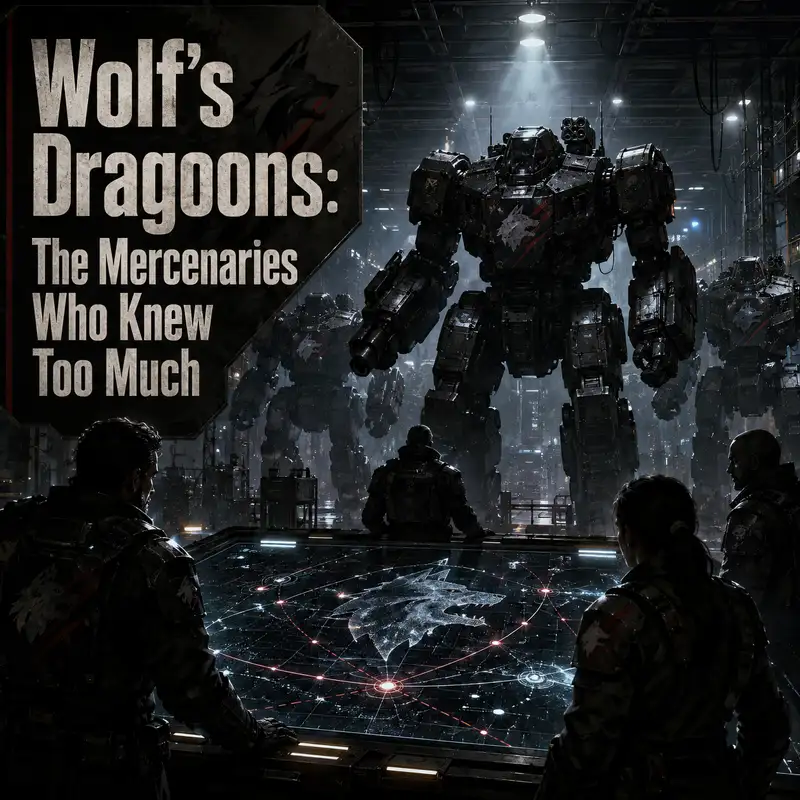
Wolf’s Dragoons: The Mercenaries Who Knew Too Much
On the eleventh of April in the year thirty oh five, the sensors at Delos reported a force that should not have existed. A flotilla of JumpShips and DropShips had arrived from the direction of the Periphery carrying five regiments of pristine BattleMechs, complete support elements, technicians, dependents, and enough transport to move the entire organization without assistance. The newcomers had no recognized homeworld, no established hiring record, and no political sponsor anyone could identify. Their commander, Jaime Wolf, offered a simple explanation. They were mercenaries looking for work.
Almost none of that explanation was false. Wolf’s Dragoons did accept contracts, fight for pay, negotiate support, and suffer casualties like other mercenary commands. The deception lay in what they were doing while they fought. They had been sent to study the Inner Sphere from inside its armies. Every campaign was reconnaissance. Every staff meeting was an intelligence opportunity. Every supply failure, political argument, and battlefield success became part of a report intended for enemies the Great Houses did not know existed.
The mission began five years earlier, far beyond the Inner Sphere. The descendants of Aleksandr Kerensky’s exiles had become the Clans, a society divided over what should be done about the worlds their ancestors had abandoned. Crusaders argued that the Clans should return as conquerors and restore the Star League by force. Wardens believed their role was to protect or guide the Inner Sphere rather than subjugate it. By the year three thousand, the Crusaders were pressing for an invasion even though the Clans possessed dangerously little current intelligence about their intended target.
Clan Wolf Khan Kerlin Ward proposed a compromise. Before the Clans committed themselves to an interstellar conquest, they would send a covert force to determine what the Successor States could actually do. The unit would pose as a mercenary command, enter the service of each Great House in turn, and observe the military strength of one state while fighting against another. The proposal delayed an immediate invasion and gave the Wardens time. It also created one of the most unusual reconnaissance units in military history: an army-sized intelligence operation with its own payroll.
Jaime Wolf and his brother Joshua were selected to lead it. Most of the volunteers were freeborn Clan warriors, meaning they had been born naturally rather than through the Clan genetic breeding program. A smaller number of trueborn warriors joined them, including Natasha Kerensky. Clan Goliath Scorpion helped train the new force for more than two years. The Dragoons had to unlearn obvious Clan habits, adopt lance and regiment structures, study Star League-era methods, and fight in a style that Inner Sphere observers would find recognizable.
The disguise was imperfect before the unit even departed. Clan planners equipped the Dragoons with machines they considered old and unremarkable. To people living after centuries of Succession War destruction, many of those machines were neither. Fleas, Falcons, and Hoplites were rare or effectively extinct. Imps and Annihilators were unfamiliar. The Dragoons also possessed an extraordinary transport fleet, specialized support units, and equipment maintained to standards most House regiments could only remember from archived readiness reports. Nothing says inconspicuous quite like five regiments of immaculate machines no one else can replace.
Before entering the Inner Sphere, the Dragoons concealed some of their most revealing assets in the Bristol system. The hidden matériel included advanced equipment and six WarShips, vessels whose appearance would have destroyed any chance of passing as ordinary mercenaries. What continued onward was still astonishing, but at least it could be explained as the result of a remarkable Star League cache. That became the most convenient theory. It accounted for the equipment without requiring anyone to imagine an advanced human civilization beyond the Periphery.
The organization was designed to gather information at several levels. The Seventh Kommando handled special operations and intelligence work. Regimental staffs studied doctrine, planning, communications, and command relationships. Technical crews observed what equipment each state could repair, what it had to cannibalize, and which parts were becoming impossible to obtain. Contract officers learned how governments funded campaigns and pressured private troops. Ordinary MechWarriors saw how House units behaved when orders failed, officers died, or supply columns arrived late.
Mercenary service made this access possible. A spy hidden in a ministry might read classified reports. Wolf’s Dragoons could watch the report become a battle plan, deploy beside the troops expected to execute it, and then fight the enemy who had prepared the opposing plan. Afterward, they could examine captured equipment, interview prisoners, study casualty replacement, and compare official claims with what had occurred. No Great House could perform that comparison across all five states. The Dragoons were building a military picture of the entire Inner Sphere one contract at a time.
The Federated Suns hired them first. Ian Davion granted the command a base on New Valencia, where the Dragoons established quarters for their dependents and support personnel. The newcomers were disciplined, courteous, and unusually self-contained. They did not behave like pirates wearing a mercenary insignia, which relieved local officials. They also refused to explain their origin, which relieved no one. House Davion accepted the mystery because five excellent regiments were more useful on the Capellan border than under prolonged questioning at Delos.
From the year thirty oh five through thirty oh nine, the Dragoons fought the Capellan Confederation on operations including Halloran the Fifth, Styk, and New Aragon. They demonstrated excellent coordination, aggressive reconnaissance, and technical readiness. At the same time, they studied both sides. Federated Suns officers revealed how their forces planned and delegated. Capellan defenders revealed how they used intelligence, local preparation, and political control to compensate for material disadvantages. The Dragoons were paid to defeat one state while learning how both states might resist a future Clan attack.
Combat also gave them a reputation they could not fully control. Success attracted attention from rival mercenaries, House intelligence services, and ComStar. Their equipment losses raised questions about replacement. Their commanders were young for the responsibilities they held. Their tactics were familiar enough to avoid exposing Clan origins, yet refined enough to appear unusual. Jaime answered questions by declining to answer them, a method that preserved the secret while making the secret more interesting.
After the New Aragon campaign, the Dragoons gathered on New Valencia and began intense spacecraft activity. They then disappeared on what was officially presented as a private logistical movement. Months later, the command returned with losses replaced and stockpiles restored. A Successor State would have struggled to rebuild five damaged regiments that quickly. A supposedly independent mercenary command had done so without requesting the parts, factory time, or financial assistance normally required. The Star League cache explanation survived, but it was beginning to carry a great deal of weight.
The Federated Suns offered titles and a more permanent place in its military system. Jaime refused. In February of the year thirty ten, the Dragoons entered Capellan service instead, with a clause preventing their new employer from using them against the Federated Suns. The provision protected their professional reputation, but it also served the reconnaissance plan. The Dragoons needed to move among the Great Houses without making every previous employer a permanent enemy. A spy mission conducted by five regiments requires unusually careful exit clauses.
Under House Liao, the Dragoons fought the Free Worlds League and learned another political system from the inside. They won important actions, then found themselves assigned to garrison duty on Carver the Fifth. The change limited combat bonuses and placed financial pressure on the command. Whether the Capellan leadership intended to weaken their independence or simply control an expensive asset, the result was instructive. A mercenary force could possess extraordinary military power and still be vulnerable to accounting, basing rights, and an employer who controlled access to useful work.
Maximilian Liao eventually placed the Dragoons at the disposal of Duke Anton Marik, who was preparing to overthrow his half-brother Janos. The assignment gave the Dragoons direct access to the Free Worlds League’s internal divisions. It also placed them inside a rebellion whose political assumptions were far less reliable than its opening plans. Anton expected the prestige and combat power of Wolf’s Dragoons to attract support. The Dragoons expected a contract that preserved their command structure and paid what had been promised. Both expectations survived only the early victories.
As Anton’s position deteriorated, he ordered the Dragoons broken into smaller formations and distributed among his regular troops. Jaime regarded the order as militarily disastrous and a violation of the contract. Payment was already overdue. He refused. Anton answered by seizing the Dragoon dependents and personnel still within his reach. Twenty-eight hostages were executed, including Joshua Wolf, Jaime’s wife, and their two younger children. The intelligence mission had prepared the Dragoons to study dynastic warfare. It had not made their families safe from a desperate dynast.
The retaliation on New Delos was immediate and devastating. The Dragoons attacked Anton’s remaining forces, while Natasha Kerensky led the newly formed Black Widow Company against his fortified compound. Anton was killed and his revolt collapsed. The operation established that the Dragoons would not accept the usual assumption that an employer could use dependents as leverage over hired troops. It also changed the command internally. The people who had entered the Inner Sphere as members of a covert Clan mission were now bound by shared loss suffered there.
Janos Marik chose not to continue the fight against them. He hired them. The decision was practical. The Dragoons were exhausted but still formidable, and employing them was safer than forcing them into another enemy’s service. From the year thirty fifteen through thirty nineteen, they operated for the Free Worlds League, recovering strength and conducting raids against Lyran targets. They also suffered a major defeat during a deep strike toward Hesperus the Second. Superior training did not make them immune to faulty intelligence, prepared defenders, or the arithmetic of fighting twice their numbers.
The losses around Hesperus created another mystery. In the year thirty nineteen, the Dragoons disappeared. Early the next year, they returned with five regiments restored to full strength. For the Great Houses, the event confirmed that Jaime possessed a hidden industrial base or cache beyond ordinary reach. The truth was more important. The Dragoons had completed their final supply run to the Clan Homeworlds, bringing years of observations about the Inner Sphere back to the society that had sent them.
Kerlin Ward used that meeting to alter the mission. He feared the Crusaders would eventually force an invasion and believed conquest could devastate the Inner Sphere. Jaime and Natasha received orders to stop reporting to the Clans and prepare the Successor States to resist. Navigational information leading back to Clan space was purged from Dragoon records, cutting the unit off from its origin. The new purpose was concealed even from much of the command. The Dragoons returned as mercenaries, but they were no longer functioning as an obedient reconnaissance arm of the Clan Grand Council.
This was not a clean conversion from enemy spies into uncomplicated defenders. The Dragoons still signed contracts, attacked worlds, destroyed equipment, and served rulers whose policies could be brutal. Their new order did not provide a detailed program for saving the Inner Sphere. It gave Jaime a strategic direction and left him to interpret it. Preparing five rival states to survive a future invasion while concealing the invasion’s existence was a task of impressive difficulty, even before those states began hiring the Dragoons to fight one another.
The Lyran Commonwealth became their next employer. During operations against the Draconis Combine, Jaime encountered Minobu Tetsuhara, a Kurita officer who allowed him to withdraw rather than destroy his damaged and overheated Archer in an unequal fight. The incident created mutual respect between men raised in very different military cultures. It also reinforced a lesson the reconnaissance reports could not capture completely. The Successor States were not merely governments, production figures, and force tables. They were institutions inhabited by individuals capable of acting beyond the stereotypes their enemies preferred.
Near the end of the year thirty twenty-two, the Dragoons left Lyran service and signed with the Draconis Combine, the last Great House they had not yet served directly. Tetsuhara became their liaison and developed a close friendship with Jaime. The Dragoons were based on An Ting and rotated forces through several garrison worlds. They also raided the Federated Suns, fought alongside Kurita troops, and observed the Combine’s command structure from within. By this point, their original circuit was complete. They had served every Successor State and fought every one of them.
House Kurita wanted more than their combat power. The Coordinator ordered the creation of the Ryuken, formations trained and organized using the Dragoons as a model. Tetsuhara was placed in command of the effort. This was the mission’s strangest result. A force sent to measure the Great Houses was now teaching one of those Houses how to improve. The Dragoons were gathering information for a future war while their target copied the methods that made them effective. Reconnaissance had become military exchange, whether Clan planners would have approved or not.
The Dragoons’ success also created hostility. Warlord Grieg Samsonov wanted direct control over their formations, and Jaime refused to surrender the command’s contractual independence. Samsonov saw an armed organization with its own transport, intelligence network, supply sources, and loyalty structure operating inside his district. From a mercenary perspective, the refusal was normal self-preservation. From a warlord’s perspective, it looked like a private army that accepted money while reserving the right to ignore political authority.
By the year thirty twenty-five, Wolf’s Dragoons possessed something no intelligence ministry could duplicate. They understood the practical differences between the Great Houses because they had lived inside each military system. They knew which commands encouraged initiative and which punished it, where provincial politics weakened concentration, which industries mattered, how quickly damaged regiments could be rebuilt, and how different governments treated mercenaries when contracts became inconvenient. They knew the distance between a state’s official doctrine and what its troops could sustain after three weeks of disrupted supply.
They also knew the secret behind the greatest strategic question of the age. Kerensky’s descendants had survived. The Clans possessed advanced weapons, functioning WarShips, superior industrial capacity, and a warrior society preparing itself for return. The Great Houses were not simply competing with one another over the ruins of the Star League. They were exhausting themselves in front of an enemy that still regarded those ruins as an inheritance. The Dragoons could not reveal that truth without exposing their own origins and perhaps provoking the invasion they were ordered to delay.
Knowledge therefore became both protection and burden. Their information made them valuable to every employer, but their secrecy made every employer suspicious. Their hidden supply system allowed them to remain independent, but independence frightened rulers accustomed to controlling military force through land, titles, family, and logistics. Their contract history gave them access across borders, but it also produced enemies, blood feuds, and civilians who remembered Dragoon attacks rather than the secret purpose behind them.
The disguise changed the people wearing it. Dragoons married, raised children, recruited support personnel, built relationships with local communities, and buried their dead on Inner Sphere worlds. Anton Marik’s executions made that transformation impossible to treat as administrative cover. The command was still shaped by Clan training and hidden orders, but it was no longer an expedition whose members could observe the Inner Sphere from emotional distance. The society they had been sent to evaluate had become the place where they lived.
ComStar found the Dragoons particularly troubling. The communications order could monitor contracts, messages, and political movements across the Inner Sphere, yet it could not explain the command’s origin or resupply. A force with independent transportation and access to unknown caches represented both an intelligence failure and a technological threat. The Dragoons knew enough about ComStar to understand the danger of attracting its full attention. ComStar knew enough about the Dragoons to recognize that the mercenaries knew more than they admitted. Neither side possessed the complete answer.
Their greatest secret remained compartmented. Most Inner Sphere observers saw an elite mercenary organization with strange equipment and an unknown past. Many ordinary Dragoons understood the command’s traditions without knowing the full strategic purpose Jaime carried. This separation protected the mission if personnel were captured or interrogated. It also created future strain. An organization cannot conceal the reason for its existence from its own members forever without making identity itself a command problem.
When the Clan invasion finally began in the year thirty fifty, the Dragoons’ accumulated knowledge became more important than their BattleMechs. During the pause in the invasion, Jaime summoned political and military leaders to Outreach and revealed the truth. He explained that the attackers were the descendants of Kerensky’s exiles, described their society and methods, and helped prepare Inner Sphere forces to resist them. The mysterious mercenaries of thirty oh five had spent decades becoming the one organization able to interpret the enemy.
That revelation did not erase their earlier service. Worlds attacked by the Dragoons had still been attacked. Soldiers killed by them did not become less dead because the command possessed a hidden Warden purpose. The Dragoons had gathered intelligence by participating fully in the wars that weakened the Inner Sphere. Their history contains the uncomfortable fact that preparation for a future defense was financed through contracts in the present conflict. Strategic necessity can explain that choice. It cannot make every consequence disappear.
Wolf’s Dragoons knew too much because they understood both sides of a war that had not yet begun. They knew the Clans were not legends, and they knew the Great Houses were neither as weak as Crusader assumptions nor as united as survival required. Their comparative knowledge made them dangerous to employers, valuable to allies, and eventually indispensable to the states they had once been sent to assess. The most important weapon they carried through Delos was not an Annihilator or a hidden WarShip. It was a map of human weakness, updated in battle, and finally used to warn the people marked upon it.