Zellbrigen: Honor, Ritual, and the Limits of Fair Combat
Andery Kerensky was alone in Cameron Park on Eden when a reinforced lance from the Ascendancy Martial Foundation caught him on the first of December, in the year twenty-eight twenty-one. He fought back and damaged several attackers, but they overwhelmed his machine and deliberately fired into the cockpit. His brother Nicholas responded by turning the manner of that death into military law. The code he formalized would become zellbrigen, the Clan rules for honorable single combat. A personal loss had become an institution that would shape warfare for centuries.
Zellbrigen is often reduced to the idea that Clan warriors prefer fair duels. That description is accurate enough to begin and far too simple to finish. The code was designed to control violence, conserve scarce resources, display individual merit, and make defeated warriors accept an outcome without widening every dispute into a campaign. It worked remarkably well when both sides belonged to the same culture. It became far less reliable when the Clans met enemies who did not share their definitions of fairness, honor, or even victory.
The practice did not appear fully formed with Nicholas Kerensky. During Operation Klondike, Clan Coyote warriors under Khan Dana Kufahl encouraged single combat, and the custom spread unevenly among the other Clans. The early conquest of the Pentagon Worlds was not governed everywhere by the rigid dueling etiquette familiar from later centuries. Clan forces still used ambushes, concentrated attacks, aerospace support, and combined arms according to conditions. Zellbrigen emerged from experience, imitation, and political choice. Later generations remembered it as ancient truth because successful institutions often acquire older ancestors than the records support.
Andery's death gave Nicholas a reason to formalize the growing custom. One warrior had been isolated and attacked by several opponents. The Clans hunted down his killers, but vengeance could not make the death orderly. Nicholas instead created rules that treated one-on-one combat as the proper measure of a warrior. The decision reflected grief, but it also served his wider project. He wanted competition without another Pentagon Civil War, aggression without uncontrolled destruction, and a military elite whose authority could be defended through visible personal performance.
Zellbrigen is only one part of the larger Clan Honor Road. It is not another word for a Trial, a batchall, or the bidding process. A Trial gives a dispute its legal form. A batchall states the objective, identifies the forces, and establishes the stakes. Bidding determines which commander will fight and how little force that commander claims to need. Zellbrigen governs how individual warriors are expected to engage once combat begins. Confusing these customs makes Clan warfare look like one elaborate duel. In reality, several overlapping institutions regulate different levels of the conflict.
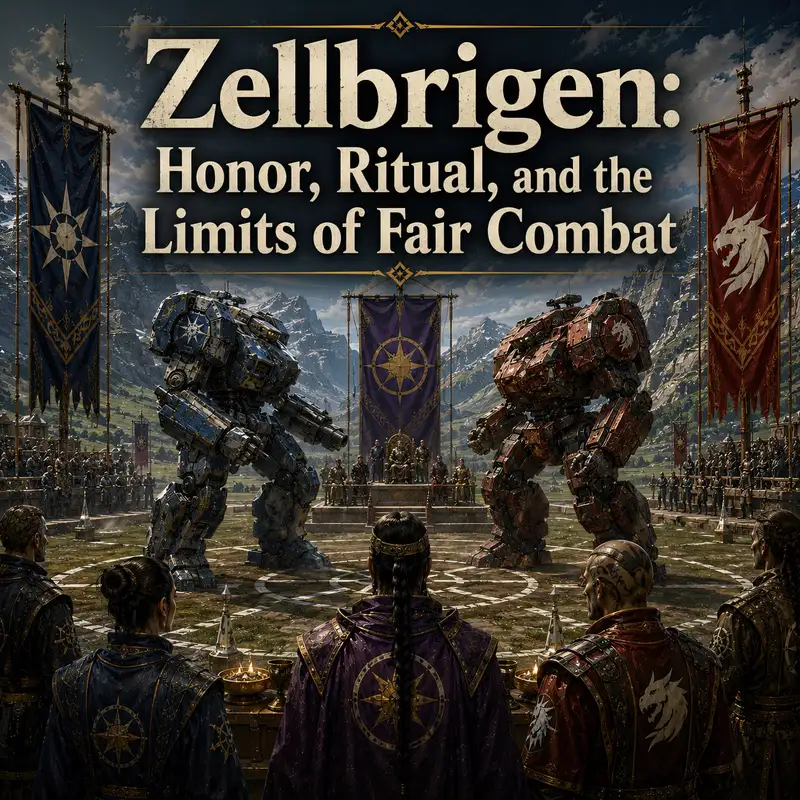
The basic procedure is direct. A MechWarrior identifies an enemy BattleMech and issues a personal challenge. Friendly warriors select different opponents. If one side has more eligible machines, the unengaged warriors wait until another duel ends or a new opponent becomes available. A warrior may challenge more than one enemy at once, accepting the combined danger as part of the claim. Challenges can also be refused under recognized circumstances, especially when a more appropriate opponent is present or when an outsider appears to be arranging a trap.
The duel is expected to remain self-contained. Artillery and area-effect weapons are normally excluded because they cannot respect the boundary between individual contests. Support systems that require another unit to guide or coordinate an attack undermine the same principle. Deliberately remaining beyond weapons range, hiding without tactical necessity, or refusing to fire when a shot is available may be judged dishonorable. Physical attacks are discouraged in many interpretations, although they are not universally forbidden. The code favors a direct contest in which neither warrior can transfer responsibility for victory to someone standing outside the circle.
Zellbrigen does not treat every combatant equally. It developed primarily around BattleMech duels. A Point of Elemental battle armor can function as a single dueling unit, as can a Point of ProtoMechs in later eras. Conventional infantry and combat vehicles do not automatically receive the same protection from a Clan MechWarrior. Clan armor and infantry units are also less restricted when engaging other branches. The code therefore limits interference among elite warriors more carefully than it limits violence against the people supporting them.
When one participant violates the accepted rules, the duel may collapse into a melee. At that point, the restrictions are lifted and every available warrior can engage freely. This is not an accidental loophole. It is the system's emergency release. A code that never permitted adaptation would invite an enemy to cheat without consequence. Even so, the warrior accused of breaking zellbrigen may face disgrace, loss of rank, or more severe punishment. The possibility of a melee creates flexibility, while the social penalty makes warriors hesitate before declaring that honor no longer applies.
The practical logic was strongest in the Clan Homeworlds. Population was limited, advanced machines were valuable, and industrial facilities could not be replaced casually. Two Clans might contest a mine, factory, genetic legacy, or settlement. A conventional campaign could destroy the object they were fighting to possess. A small number of duels could settle ownership while leaving the infrastructure and most of both forces intact. To an outsider, the ritual could look theatrical. To a quartermaster responsible for replacing an OmniMech factory, it had an attractive economy.
The arrangement also depended on shared legitimacy. The losing Clan accepted the result because its warriors recognized the same witnesses, procedures, and values as the winners. That reduced the need for occupation forces and prolonged enforcement. A facility could change hands after limited combat because both sides believed the Trial had produced a binding answer. Zellbrigen was therefore not merely a style of fighting. It was part of a legal system that converted battlefield performance into political authority and made honor function as a substitute for thousands of garrison troops.
That legal function strengthened the warrior caste. Clan society claimed that warriors deserved to rule because they accepted personal risk and proved themselves through combat. Zellbrigen made the argument visible. Each victory belonged to a named warrior, and each failure could be traced to an individual. The code rewarded courage, technical skill, and control under pressure. It also encouraged the belief that excellence in a cockpit demonstrated fitness to decide matters of policy, logistics, justice, and government. A good duelist can possess those abilities. The duel does not measure them.
The fairness offered by zellbrigen is procedural rather than equal. The code does not guarantee identical BattleMechs, equivalent armor damage, equal pilot experience, neutral terrain, or comparable supply. A warrior may reject a challenge from a very different weight class when another suitable opponent is available, but the larger contest still contains inequalities. Clan technology, training, and genetic selection could make an apparently balanced duel extremely one-sided. Fairness meant that the rules were known and interference was limited. It did not mean that both warriors had the same chance of surviving.
The distinction becomes sharper outside the warrior caste. A BattleMech pilot judged worthy may receive a formal challenge and, if defeated, an honorable opportunity to withdraw. An attacking force may also be granted safe conduct to land for the contest. A tank crew can be engaged without the same ceremony. Infantry may be attacked by weapons the code would prohibit inside a MechWarrior duel. Civilians benefit when limited fighting preserves a city or factory, but zellbrigen does not grant them equal standing. It is a code among warriors, written by warriors, for a society ruled by warriors. Its restraint is real, and so is its hierarchy.
Clan warfare remained combined-arms warfare despite the emphasis on duels. Toumans included aerospace fighters, Elementals, vehicles, artillery, engineers, transport, reconnaissance, and technical support. The code did not erase those branches. It organized their interaction unevenly. Elementals could duel as a Point, conventional forces could fight under different expectations, and commanders could still maneuver formations at the operational level. The difficulty appeared when the most prestigious arm of the force treated a coordinated battle as a collection of private contests.
Concentration of force is one of the oldest principles of war. Several units combine effects against a decisive target, destroy it quickly, and then move to the next problem. Zellbrigen works in the opposite direction. It distributes attention among opponents, discourages outside fire, and can make a Star of OmniMechs behave like five separate commands. Against another Clan force following the same rules, the symmetry controls the risk. Against an Inner Sphere company using massed fire, artillery, hidden reserves, and disciplined withdrawal, the symmetry exists only in the Clan commander's expectations.
Individual Clans never interpreted zellbrigen identically. Clan Jade Falcon traditionally treated larger battles as a series of personal duels and placed great value on how victory was achieved. Clan Wolf used a more flexible interpretation, especially when operational success required it. Clan Diamond Shark could honor a direct challenge while remaining willing to bomb a position or seize a supply cache rather than conduct a wasteful frontal attack. All three could claim fidelity to Clan principles. The disagreement lay in whether honor required the ritual itself or the efficient result the ritual was supposed to produce.
The opponent's status mattered as much as the warrior's Clan. Pirates, bandits, and forces declared unworthy could be denied normal protections. A Trial of Annihilation did not require the restraint expected in an ordinary contest. During the invasion of the Inner Sphere, warriors could refuse suspicious challenges and later reserve zellbrigen for opponents considered honorable. This flexibility prevented the code from becoming completely suicidal. It also gave the warrior caste power to decide who counted as a peer and who could be attacked without ceremony.
When Operation Revival reached the Inner Sphere, the cultural assumption behind zellbrigen failed before the weapons did. Clan warriors issued challenges over open communications and expected enemy pilots to recognize their meaning. Some defenders responded. Others concentrated fire, withdrew into prepared positions, or ignored the challenge entirely. The Clans' early victories concealed the problem because superior range, armor, training, and battle armor often overcame tactical self-restraint. A custom appears universal when the people practicing it keep winning.
The Battle of Wolcott in October of the year thirty fifty showed how quickly an opponent could learn to use the wider honor system. The engagement was governed by a batchall rather than zellbrigen alone, but the same assumptions were at work. Hohiro Kurita accepted the Smoke Jaguar challenge and offered clear stakes. If the Jaguars won, they would take the world. If the Combine won, the Jaguars would surrender four OmniMechs, twenty-four Elemental suits, and promise never to attack Wolcott again.
Theodore Kurita had already chosen the battlefield. Swamp Valley was hot, foggy, wooded, and capable of reducing the Jaguars' range and sensor advantages. Reflective strips hung among the trees confused targeting systems. Traps and vibrabombs restricted movement. Hidden supply points supported repeated attacks. Most importantly, two elite Genyosha regiments had been given false identities as inexperienced Yuutsu formations. Jaguar commander Dietr Osis accepted the terms because he believed he faced green troops and because Hohiro carefully made hesitation look like fear.
The Jaguars entered a prepared operational trap and lost. They then honored the agreement. Wolcott remained beyond their reach, and the captured equipment gave the Draconis Combine valuable Clan technology to study. The result shows why the honor system was more than foolish pride. It turned one battlefield defeat into an enforceable strategic limitation without requiring the Combine to defend every approach forever. It also shows the danger. Clan honor made the promise binding, while Jaguar confidence and incomplete intelligence made the promise possible.
Whether Hohiro's deception was honorable depends on which military culture is permitted to define the word. A Clan traditionalist could condemn the false unit records, concealed preparations, and refusal to reveal actual strength. The Combine could answer that Hohiro accepted the stated contest, defended his own world, and used every lawful advantage against an invader. The Jaguars had recently demonstrated at Turtle Bay that Clan ideas of honorable warfare did not guarantee mercy for an Inner Sphere population. No shared court existed to settle the moral argument. Only the batchall's result bound both sides.
Turtle Bay exposed the deepest limit of the code. After resistance helped Hohiro escape captivity, Smoke Jaguar forces withdrew from the capital city of Edo and destroyed it from orbit. The bombardment killed civilians on a scale that shocked even other Crusader Clans. Clan Wolf responded by bidding away naval assets from future planetary conquests, and honor pressured the other invaders to follow. Zellbrigen could protect a worthy MechWarrior from interference while failing to protect a city from collective punishment. The broader honor system reacted to the atrocity, but only after warrior leaders chose to recognize it as dishonorable.
Tukayyid tested the Clans at a scale no individual duel could control. In May of the year thirty fifty-two, Anastasius Focht accepted a Trial that would decide whether the Clans could continue toward Terra. The Com Guards did not fight as a collection of champions. They used prepared terrain, fortifications, artillery, mines, reserves, repeated withdrawals, and attacks on supply. Focht intended to delay, exhaust, isolate, and destroy formations rather than offer each Clan warrior a satisfying personal contest.
Zellbrigen did not by itself cause the Clan defeat. Dangerous bidding, poor logistics, rivalry among the Clans, weak intelligence, unfamiliar terrain, and overconfidence were at least as important. The code did shape tactical habits inside those larger failures. Warriors were trained to seek visible opponents, measure themselves through direct engagement, and regard withdrawal or outside assistance with suspicion. Those instincts could produce extraordinary courage. Against an enemy whose objective was to consume time, ammunition, and momentum, courage sometimes accelerated the exhaustion.
Clan Wolf provided the important contrast. The Wolves interpreted zellbrigen more liberally, planned their campaign carefully, and paid serious attention to logistics. They achieved their objectives while most of the other Clans failed, with the Ghost Bears gaining only a limited success and the Jade Falcons forcing a costly draw. The comparison does not prove that honor was useless. It shows that ritual had to remain subordinate to the mission. The Wolves preserved enough of the code to remain Clan warriors without allowing every duel to dictate the campaign.
The rule that a broken duel becomes a melee gave commanders a way to adapt, but adaptation was not instantaneous. Someone had to recognize the violation, communicate what had happened, and decide that unrestricted engagement was justified. A warrior who abandoned zellbrigen too early risked disgrace. One who waited too long risked destruction. Inner Sphere forces could exploit that hesitation by interfering at the moment of greatest advantage. On a battlefield measured in seconds, a cultural argument conducted over the radio is still a delay.
Aerospace combat forced the Clans to revise their customs further. Clan commanders had often treated DropShips as protected transport and focused on the ground battle that would decide possession. Inner Sphere forces had no reason to allow an enemy DropShip to land unopposed. As the invasion exposed that difference, comparable rules were developed for fighter engagements, including matched opponents and limits on how many fighters would attack a smaller formation. The change demonstrated that zellbrigen was living doctrine. Operational pressure could modify even a tradition presented as timeless.
Other customs surrounded the duel. Safcon granted an attacker safe conduct to land for a Trial. Hegira allowed a defeated force to withdraw honorably. These were not zellbrigen, but together they could place boundaries around an entire operation. Transport arrived, combat occurred under agreed conditions, and the loser departed without being hunted to destruction. The arrangement conserved ships, warriors, and infrastructure. It worked only while both sides valued future participation in the same system more than the immediate advantage available through betrayal.
That condition explains both the strength and fragility of Clan honor. Inside Clan space, a commander who violated the code could lose rank, political support, Bloodhouse standing, and the trust required for later Trials. The sanction was powerful because the warrior had to keep living within the community. An Inner Sphere officer defending a threatened world faced a different calculation. Reputation before the Grand Council mattered less than preventing occupation. The Clans possessed rules for punishing their own dishonor. They had no authority capable of making an outsider feel ashamed.
Zellbrigen was also poorly suited to occupation and insurgency. A duel could determine which flag flew over a factory. It could not make the workers loyal, persuade a city to accept caste assignment, or prevent resistance from reorganizing after the warriors moved on. Civilians did not necessarily regard a Trial they had never approved as a legitimate transfer of government. When resistance continued, Clan commanders had to police populations, protect supply routes, gather intelligence, and manage political grievances. The code that settled contests among warriors offered little guidance for those tasks.
Later Clan practice reflected these lessons. Universal application against Inner Sphere opponents declined. Many warriors continued to use zellbrigen in inter-Clan combat or against enemies judged worthy, while others treated it as optional when circumstances demanded massed action. Individual Clans moved toward stricter or looser interpretations according to experience, politics, and leadership. The code survived because it could change without surrendering its symbolic value. A warrior could still invoke the old ritual, but fewer commanders assumed the enemy would organize the entire battlefield around it.
Zellbrigen was never simply foolish chivalry, and it was never a universal law of fair war. It was a rational answer to a particular problem: how a small, militarized society could permit constant competition without destroying the people and machinery it needed to survive. It limited damage, created enforceable outcomes, and gave courage a recognized political language. The same system fragmented combined arms, privileged the warrior caste, and confused agreement among peers with legitimacy among everyone affected by the result.
The code worked best when the objective was limited, the participants shared the rules, the result could be enforced through honor, and no civilian population was expected to mistake a duel for consent. It failed when war involved hidden forces, asymmetric goals, total mobilization, occupation, or an enemy willing to concentrate every available weapon on the most dangerous target. The Circle of Equals could make combat smaller and sometimes more humane. The Clans' great mistake was believing that the circle contained the whole battlefield.