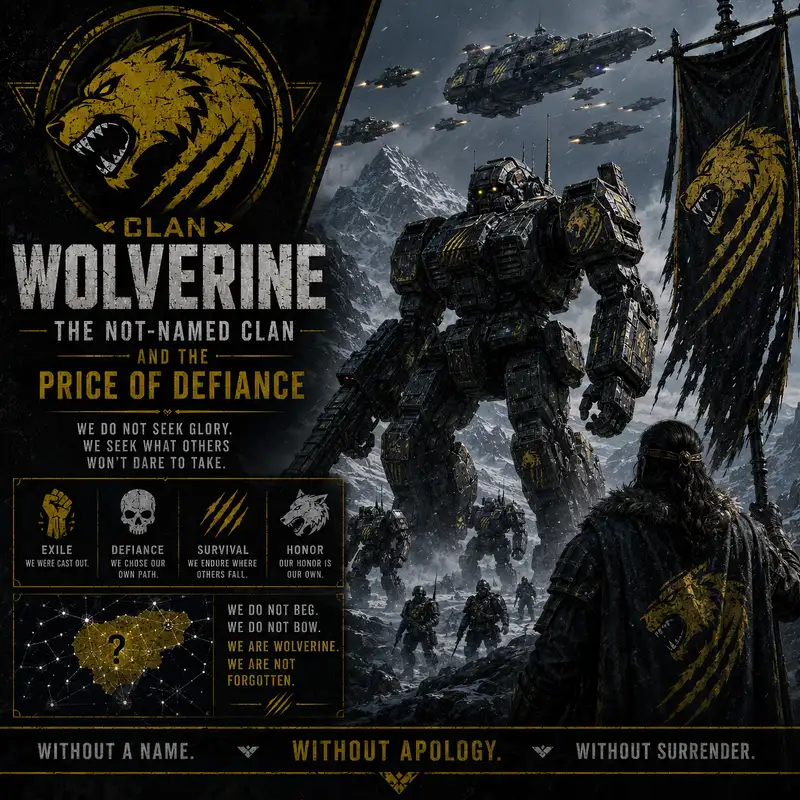
Clan Wolverine: The Not-Named Clan and the Price of Defiance
At Barbados, Nicholas Kerensky buried Franklin Hallis beneath a marker that named him Khan of Clan Wolverine. The gesture was private, almost respectful. The order issued to the rest of Clan society was the opposite. The Wolverines were to disappear from records, genetic archives, military histories, and ordinary speech. Their name became an offense. Their survivors became prey. Nicholas could acknowledge Hallis as a legitimate leader at a grave no one was meant to find, while commanding every future Clansman to pretend Hallis and his people had never existed.
That contradiction is the center of Clan Wolverine’s history. The Clan was not merely defeated in a Trial or absorbed by a stronger rival. It was turned into the Not-Named Clan, a warning placed inside Clan culture. Official history described traitors who defied lawful authority, used nuclear weapons, and endangered the entire society. The concealed record shows political rivalry, manipulation, a false accusation, and a punishment chosen before the most serious crime had occurred. The price of Wolverine defiance was therefore larger than military destruction. It was the deliberate replacement of history with doctrine.
Clan Wolverine began on the eleventh of June, in the year twenty-eight oh-seven, with the other nineteen original Clans. Its first Khan was Sarah McEvedy, a veteran of the Star League Defense Force and the daughter of Lieutenant General James McEvedy, last commander of the Three Hundred Thirty-first Royal BattleMech Division. She had followed Aleksandr Kerensky into exile, survived the Pentagon Civil War, and supported Nicholas during the Second Exodus. She also knew the difference between loyalty to a leader and surrendering every independent judgment to that leader.
Nicholas named the Clan for the wolverines adapted to the tundra of Strana Mechty. The animal was smaller than many predators around it, but notoriously unwilling to retreat from a larger opponent. That reputation suited McEvedy’s people. Many came from the old Three Hundred Thirty-first or shared its traditions. They valued unit cooperation, practical leadership, and the belief that the Star League had been more than an army. To them, preserving Kerensky’s legacy included professional military service, civic responsibility, and enough personal freedom to challenge a bad order.
The Wolverines were still a Clan. Warriors ruled, military competition mattered, and their society was not a modern representative democracy hidden beneath an animal emblem. Their difference was one of degree and direction. McEvedy allowed limited movement between castes when food production or other essential work required it. She encouraged cooperation rather than rigid separation. Civilian efficiency mattered because a warrior caste without farmers, technicians, and transport crews is only a very disciplined group waiting to become hungry.
Operation Klondike showed how this culture fought. Clan Wolverine and Clan Snow Raven were assigned to northern Circe in the year twenty-eight twenty-one. Against the Rasmussen Elite, McEvedy used coordinated fire, artillery, maneuver, and the combined methods of the old Star League Defense Force. The Elite’s warriors were skilled enough that treating the battle as a sequence of individual duels would have been expensive and unnecessary. The Wolverines concentrated force and destroyed them. It was effective warfare, but it moved away from the personal combat rituals Nicholas wanted the Clans to adopt.
The campaign also strengthened the Wolverines materially. Survivors connected to the old Three Hundred Thirty-first joined them. Their settlements developed a productive agricultural and industrial base. Scientists produced improved weapons and advanced BattleMech designs, including work on a more capable extended-range particle projection cannon. Other Clans saw a successful rival gaining technology, people, and prestige. Nicholas saw something more dangerous. Clan Wolverine was proving that a Clan could prosper while interpreting his social system less rigidly than he intended.
Success created enemies. Clan Widowmaker Khan Jason Karrige placed agents among the Wolverines and encouraged other Clans to challenge them repeatedly. His motives included political ambition and a personal grievance against McEvedy, though the surviving record does not explain every part of that hostility. Karrige reported Wolverine caste practices to Nicholas, spread suspicion about their loyalty, and treated each dispute as an opportunity to make the Clan appear outside the common order. He was not powerful enough to destroy them alone. He was skilled enough to persuade others that destruction might serve their own interests.
In June of the year twenty-eight twenty-two, Nicholas confronted McEvedy over caste movement. She had permitted people to shift into labor assignments to improve food output. Nicholas regarded this as interference with the system he had created. The argument was not really about a few agricultural transfers. It concerned who possessed authority to change Clan society. McEvedy believed a Khan had to adjust institutions to practical conditions. Nicholas believed local adaptation could unravel the uniform order meant to prevent another Pentagon Civil War.
The dispute became far more dangerous in the summer of twenty-eight twenty-three. A previously unknown Brian Cache was found in Wolverine territory in Circe’s Tiki Province. The depot contained weapons and equipment associated with the Three Hundred Thirty-first, including tactical nuclear devices. Clan Jade Falcon challenged for the cache and lost. McEvedy considered the depot part of Wolverine territory, military inheritance, and the logistical foundation of her people. Nicholas considered its contents too important for one Clan to control.
Both positions had military logic. The Wolverines had discovered and secured the facility, and much of its equipment came from the division that formed their institutional core. The Grand Council also had reason to worry about one rival controlling a large reserve of advanced weapons and nuclear arms. The issue could have been settled through inventory, negotiated division, or tightly supervised Trials. Instead, it arrived inside a political climate already shaped by spying, jealousy, and Nicholas’s determination to make Clan Wolverine conform.
Nicholas ruled that the cache would be shared through Trials of Possession. McEvedy demanded a Trial of Refusal. She and saKhan Dwight Robertson faced Widowmaker opponents who concentrated first on Robertson and then on her. Robertson was killed, and McEvedy was wounded before Nicholas stopped the fight. The result was legally valid under Clan procedure. It also confirmed the Wolverine belief that the procedure was being used to remove their leadership one warrior at a time.
McEvedy promoted Franklin Hallis to saKhan without another Trial. Nicholas refused to recognize him, citing the very customs McEvedy believed had just been manipulated against her. She also revealed that a covert intelligence organization was monitoring the Clans and argued that its exclusion of the Wolverines made fair judgment impossible. By this point, every challenge became evidence for both sides. Nicholas saw defiance of law. McEvedy saw law being redesigned whenever ordinary procedure failed to produce the desired punishment.
The concealed account places the decisive moment during a private meeting aboard McKenna’s Pride. McEvedy offered compromises and tried to prevent open conflict. Nicholas praised the strength of her Clan, then made clear that the dispute had moved beyond the Brian Cache. The Wolverines’ liberalization, independence, and repeated opposition threatened his vision. They would be destroyed as an object lesson. Once that decision was made, the next council session was no longer a negotiation. It was preparation for the official explanation.
McEvedy and Hallis had already begun Operation Switchback. Technicians and crews reclaimed mothballed JumpShips and WarShips from old fleet boneyards. Supplies, families, civilian specialists, and military equipment were gathered for another exodus, this time back toward the Inner Sphere. The plan required secrecy, functioning jump drives, and coordination across holdings on Circe, Lum, and Strana Mechty. Every hull reclaimed from storage needed crews, seals, drive inspections, food, and parts no longer in routine production. The operation was less a raid on a boneyard than an emergency mobilization of a state already under surveillance. It also required people to abandon homes they had built after two previous migrations. Military history often calls that a withdrawal. The families loading medical records and seed stock usually experience it as the loss of a country.
On the eleventh of October, in the year twenty-eight twenty-three, McEvedy renounced her place in the Grand Council and declared that Clan Wolverine would leave Clan society. A Smoke Jaguar Khan called for a Trial of Absorption, which would have dissolved the Clan and divided its people and property among the victors. The Wolverines began scorched-earth evacuations, destroying facilities they could not carry. They allowed individuals to remain behind, but the choice was made under conditions where staying could mean being identified with a condemned political movement.
Then Great Hope exploded. Widowmaker agents had stolen one of the nuclear weapons from the Brian Cache and placed it in the Wolverine capital. Karrige detonated it as Nicholas and attacking forces approached, ensuring the blast would appear to be a Wolverine act of desperation. McEvedy was believed killed. The destruction provided exactly the evidence needed to transform a political dispute into a moral emergency. The Wolverines were no longer described as secessionists. They were presented as nuclear criminals willing to destroy their own city and anyone near it.
The escalation continued on Circe. Clan Snow Raven attempted to use a nuclear weapon against retreating Wolverine forces. A reclaimed Wolverine WarShip shot down the delivery craft, and the armed device detonated over the Raven capital of Dehra Dun. That catastrophe was also placed on the Wolverine ledger. Franklin Hallis then seized McKenna’s Pride and used orbital fire against Clan halls and the Grand Council complex while extracting his remaining forces. The Wolverines had been framed for the first nuclear attack, but their escape was not bloodless or restrained.
This distinction matters. Clan Wolverine was not a community of harmless reformers politely requesting a different administrative code. Its leaders violated Clan procedures, threatened violence in the council, destroyed facilities during withdrawal, and bombarded political and military targets from orbit. Once McEvedy concluded that lawful escape was impossible, she chose armed secession. Those actions gave Nicholas genuine security concerns. They did not justify the fabricated accusations, collective punishment, or decision to erase every civilian child carrying the wrong identity.
On the twenty-fifth of October, Nicholas announced the first Trial of Annihilation against an entire Clan. Every Wolverine warrior was to be killed. Civilians would be chemically sterilized and absorbed into other Clans. Genetic repositories would be destroyed, Bloodnames eliminated, and no quarter offered. This was not a larger version of an ordinary Trial of Possession. It was a program to prevent the community from reproducing biologically, culturally, or historically.
Clan Wolf won the formal right to conduct the Annihilation, though the pursuit became a wider Clan operation. Hallis divided the escaping fleet. He commanded one group from the Star League vessel Michigan, while Trish Ebon led another. The split increased the chance that some people might survive, but reduced mutual protection and complicated supply. Their strategy attempted to let the pursuing Grand Fleet move ahead while the Wolverines remained hidden behind it. Such plans look elegant until a jump drive fails or a transport needs water on the wrong planet.
Official Clan history soon reported that the Wolverines had been eliminated. The actual pursuit continued. This gap was not clerical confusion. It reflected a narrative being constructed before events had finished. Records were altered, missing civilians dismissed as poor accounting, and the nuclear attacks assigned to the condemned Clan. The official story needed certainty. Admitting that thousands might have escaped would mean the Trial had failed and Nicholas’s enemies remained somewhere beyond his reach.
In June of the year twenty-eight twenty-four, the Grand Fleet found Hallis’s group at a supply world given the code name Barbados. The Wolverines had grounded ships and were vulnerable. Ebon’s force was out of position and hindered by drive trouble. The naval engagement was badly one-sided. Several vessels escaped, but the main group was trapped. On the seventh of July, the Clans bid for the final ground battle against an enemy whose defeat had already been announced months earlier.
Before the end, Nicholas revealed Jason Karrige’s treachery. Hallis was permitted to kill the Widowmaker Khan responsible for turning the crisis into nuclear war. The concession offered personal justice without changing the collective sentence. Star Colonel Ferris Ward then defeated Hallis, and the remaining Wolverine force on Barbados was destroyed. Nicholas buried Hallis as Khan, privately acknowledging the authority he had refused to recognize in council. The grave honored the man while the policy erased his people.
Sarah McEvedy’s fate remains uncertain. She survived the Great Hope explosion badly wounded and became Nicholas’s prisoner in the concealed account. Later events leave open whether she died, was abandoned on Barbados, or reached surviving Wolverines after the battle. Trish Ebon’s group did escape, joined other scattered units, and continued away from Clan space. The precise number of survivors is unknown. That uncertainty was not a small loose end. It became the reason the Clans could never treat the Annihilation as fully complete.
Clan society answered uncertainty with taboo. Wolverine records were purged. Jason Karrige’s role disappeared from the public narrative. The accidental destruction of Dehra Dun became another Wolverine crime. The animal name itself became an insult. A later Clan evolution of the Wolverine BattleMech was called the Conjurer rather than carrying the forbidden animal name. Warriors carrying Wolverine genetic connections were killed, sterilized, or driven to suicide. Even language was reorganized so that ordinary conversation would reinforce the verdict.
The Ghost Bears carried the fear further. A Bear patrol had once allowed a small Wolverine group to escape because Clan Wolf, not Ghost Bear, had won the honor of destroying them. When that decision became known, the Bears treated it as a hereditary stain and swore to hunt any descendants they encountered. Clan honor had created a loophole that saved fugitives, then created a generational oath to correct the embarrassment. The surviving Wolverines did not need to attack anyone to remain a military objective. Their existence was enough.
The destruction served Nicholas politically. The Clans were still young, their institutions untested, and their Khans accustomed to independent Star League command. Clan Wolverine demonstrated that a successful Clan might interpret law differently, strengthen its civilian base, and challenge the ilKhan openly. Annihilation transformed that alternative into treason. Every other leader now understood that disagreement could move from council procedure to biological erasure once Nicholas defined the issue as a threat to the whole.
The warning worked because it contained a simple moral story. The Wolverines had been proud. They rejected lawful sharing. They used forbidden weapons. They fled justice. Their name therefore deserved removal. The hidden history was more dangerous because it showed rules manipulated by rivals, punishment planned in advance, and nuclear violence initiated by the man whose role was later concealed. A society founded on honor could survive one treacherous Khan. It had greater difficulty admitting that the ilKhan knowingly preserved the lie because the lie stabilized his government.
There is another irony. Nicholas later adopted limited forms of caste testing and movement resembling reforms for which McEvedy had been condemned. Clan society changed because practical conditions demanded it, but the person who had pressed the issue remained a traitor. Governments often become more comfortable with an idea after removing the person who proved they did not control it. The Wolverines paid for being early, successful, and unwilling to let Nicholas claim the reform as his own.
In the year twenty-eight twenty-five, a mysterious force entered Draconis Combine space from the Deep Periphery. It used Star League tactics, traveled with military and civilian ships, gathered supplies and personnel, and carried insignia associated with the Terran state of Minnesota. Later evidence included the number Three Hundred Thirty-one and a white wolverine with bloodied fangs. The group became known as the Minnesota Tribe. It vanished beyond the Outworlds Alliance before the Combine or ComStar could determine its destination.
The connection to Clan Wolverine is compelling, but the survivors’ final fate remains unconfirmed. Interstellar Expeditions recovered artifacts and traced the Tribe’s route. Later rumors linked Wolverine descendants to ComStar, the Word of Blake, secret colonies, and other hidden organizations. Some evidence is suggestive. Much of it comes from deliberately unreliable reports, destroyed sites, or people with reasons to manufacture a frightening explanation. The safest conclusion is that a significant remnant escaped and probably appeared as the Minnesota Tribe. What it became afterward remains open.
That uncertainty is more important than a tidy revelation. Clan Wolverine’s survival does not need to produce a hidden empire to matter. A convoy of families escaping with fragments of the Three Hundred Thirty-first, a few advanced machines, and the memory of what Nicholas did is enough. They carried a version of Clan history in which the Founder was not infallible and the Not-Named were not monsters. That memory was precisely what Annihilation had been designed to prevent.
The Wolverines paid for defiance with warriors, cities, Bloodnames, family lines, and the right to speak their own history. The other Clans paid as well. They inherited a political culture in which erasure could be called law, obedience could be called honor, and a forbidden word could replace an honest investigation. Nicholas won the immediate struggle. He did not eliminate the contradiction exposed by Sarah McEvedy. He only made it dangerous to discuss.
The last image is still the grave on Barbados. Nicholas Kerensky stood over Franklin Hallis and used the title Khan, then ordered the location removed from memory. One act admitted that the Wolverines had remained a people with a legitimate leader. The other required every Clan to deny it. Clan Wolverine became the Not-Named Clan because its military defeat was not enough. Its enemies also had to defeat the possibility that its defiance had been justified.