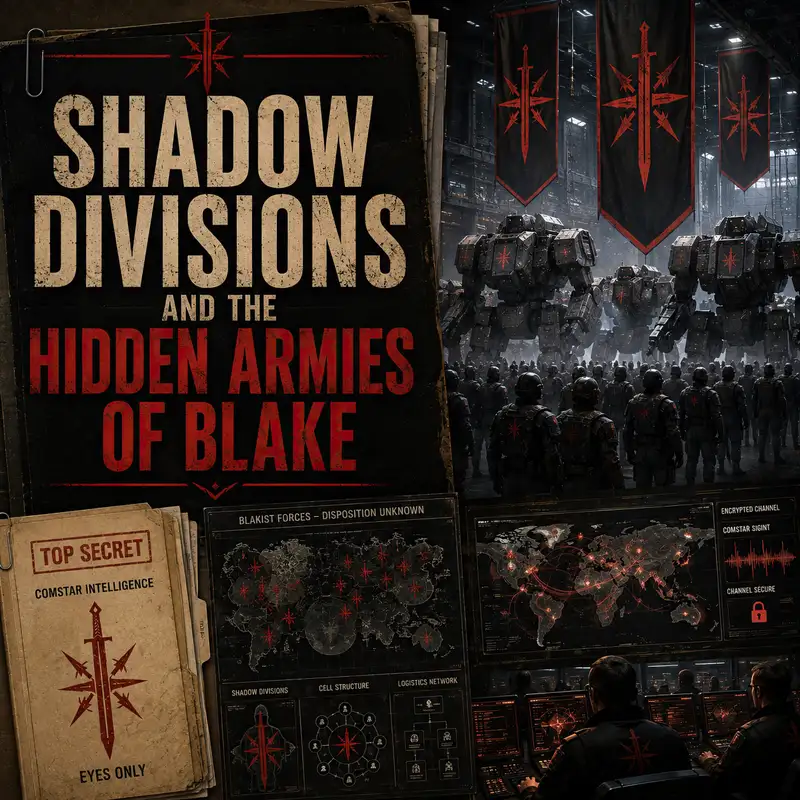
Shadow Divisions and the Hidden Armies of Blake
The surviving Com Guards who reached Normandy in March of thirty sixty-eight believed the worst part of Case White was behind them. Their DropShips had crossed Terra’s orbital defenses, their troops had reached the ground, and the battered One Hundred Sixty-sixth Division still had enough cohesion to continue the attack. Then a formation absent from every reliable intelligence estimate struck them. The Fifty-first Shadow Division appeared under Azrael, moved with speed the Com Guards had not prepared for, and shattered troops who had already survived the impossible journey down.
The surprise was not simply that the Word of Blake possessed one more elite unit. It was that ComStar had misunderstood the scale and architecture of the enemy. Public estimates had focused on a militia of roughly ten divisions guarding Terra and selected Protectorate worlds. The actual Blakist military included hidden regular divisions, local garrison armies, mercenary auxiliaries, covert forces, concealed naval assets, and thirteen Shadow Divisions answering through a chain of command outside the normal militia. Case White landed against a state whose visible army was only the portion intended to be counted.
The central question is therefore not why the Shadow Divisions were dangerous. Cybernetically enhanced veterans with advanced machines and permissive rules of engagement are rarely included in a military budget to improve workplace morale. The important question is how the Word created so many hidden forces, kept them separate from normal oversight, and then used them to attack across the Human Sphere before its enemies understood what existed.
The process began with the ComStar Schism. At least four Com Guard divisions followed the religious conservatives who became the Word of Blake. Those troops brought BattleMechs, vehicles, aerospace fighters, technicians, staff officers, doctrine, and an institutional familiarity with secrecy. The early militia defended Gibson, suppressed resistance there, and prepared the campaign that captured Terra in thirty fifty-eight. By that point, the force had roughly doubled. Additional divisions appeared soon afterward, though outsiders still believed the organization’s growth remained limited.
Terra changed the arithmetic. The Word inherited factories ComStar had restored after Tukayyid, research institutions, training grounds, the Titan shipyards, and portions of the old Space Defense System. Materials arrived through relationships with the Free Worlds League and Capellan Confederation. Hyperpulse generator revenue financed procurement. Captured industrial capacity produced new equipment while old Star League matériel returned to service. The buildup was visible in fragments, but the fragments could be explained as replacements, depot reserves, planetary defense, or naval reconstruction.
A House intelligence service counting regimental colors would have found the problem unusually frustrating. The Word retained ComStar’s base-six organization. Small Level One elements combined into Level Twos, Level Threes, and larger formations that mixed BattleMechs, armor, infantry, battle armor, aerospace assets, and support. Those blocks could train separately, move separately, and appear under temporary operational groupings. A conventional regiment normally leaves one large trail. A Blakist division could leave several smaller trails that did not look connected until they opened fire together.
The Word also controlled much of the communications infrastructure through which other governments tried to investigate it. ROM could intercept inquiries, alter records, identify agents, and decide which shipping information reached outside analysts. Procurement disappeared inside religious administration, commercial HPG operations, or classified Terran programs. A missing cargo manifest might indicate a secret BattleMech battalion. It might also indicate that an acolyte had used the wrong form. The Word had centuries of institutional experience making both explanations look equally plausible.
Secret bases widened the gap. ComStar had maintained concealed holdings known collectively as the Hidden Five, with Terra treated as the central sixth world in Blakist thinking. These sites offered storage, research, naval facilities, and locations where personnel could train beyond ordinary observation. The Ruins of Gabriel in the Odessa system became the best-known example after Chandrasekhar Kurita’s network helped expose it. By the time enemy forces reached such facilities, equipment could be removed, records destroyed, and the defenders reassigned under another name.
The regular Word of Blake Militia expanded inside this system. Many formations later identified as hidden divisions were conventional combined-arms units rather than Manei Domini commands. The Thirty-seventh Division emerged at Tharkad. The Thirty-first and Thirty-sixth fought on New Avalon. The Thirty-second appeared during the seizure of Saffel and later operated on Luthien. The Thirty-ninth remained one of Terra’s strongest conventional defenders. These troops were secret before the war, but once revealed they performed recognizable military work: conquest, garrison duty, theater operations, and attritional defense.
That distinction is essential. The Shadow Divisions did not constitute the entire hidden army. They were the offensive edge of a much larger structure. Regular militia divisions seized spaceports, held cities, protected factories, and absorbed the daily losses of occupation. Naval forces transported them and controlled orbit. ROM selected targets and penetrated defenses. Mercenary commands provided additional troops and useful deniability. The Shadow Divisions were most effective because other organizations supplied the battlefield on which they could appear decisive.
The Protectorate Militias formed another layer. These were locally raised combined-arms units tied to individual worlds. They generally possessed fewer BattleMechs and relied more heavily on vehicles, infantry, battle armor, and older equipment. Their mission was normally local defense rather than interstellar campaigning. That made them less glamorous than the Shadow Divisions and considerably cheaper to keep in place, which is a quality military finance offices have appreciated since long before anyone invented a neurohelmet.
Local recruitment served several purposes. It reduced the number of regular Blakist troops required for garrison duty, drew on planetary patriotism, and placed defenders near their families and homes. It also reduced transport demands. A militia already stationed on Bryant or Zosma did not require a JumpShip to arrive whenever raiders appeared. The Word could reserve its elite divisions and scarce interstellar lift for offensive operations while local forces guarded roads, depots, factories, and political offices.
Mercenaries filled the spaces between these formal layers. Some accepted ordinary contracts to train local troops or defend installations. Others conducted raids, supported invasions, or suppressed resistance. The arrangement let the Word add combat power without listing every hired regiment as part of its own strength. It also created unstable loyalties. A mercenary commander might accept Blakist money and still refuse an order to massacre civilians. The Martian Cuirassiers discovered that the Fifty-second Shadow Division treated such professional disagreement as a terminal administrative matter.
The Shadow Divisions themselves began as thirteen formations numbered from the Fortieth through the Fifty-second. Two more appeared late in the war. Their combat personnel were Manei Domini, the cybernetically reconstructed devotees who regarded themselves as the Hands of the Master. The divisions answered to Apollyon and, through him, directly to the Master. They did not belong to the normal chain commanded by Precentor Martial Cameron St. Jamais.
That separate command was not a minor organizational curiosity. St. Jamais controlled the regular militia and expected theater commanders to coordinate forces, supplies, and objectives. Apollyon controlled units that considered ordinary Blakist soldiers to be frails and treated the Master’s direction as superior to conventional authority. Both commands supposedly served the same cause. They did not always share intelligence, priorities, or professional respect. The Word had concealed its best striking force by building a second army inside the first, then seemed surprised when the two armies developed opinions about each other.
Shadow Divisions were intended for high-risk, high-reward operations. They struck capitals, command centers, industrial worlds, and isolated elite units. Specialized transport and super-jump operations allowed them to redeploy with speed that made their appearances seem almost disconnected from normal interstellar movement. They could arrive, concentrate several Level Threes, destroy a target, and withdraw before a distant state assembled a proper response. The effect was operational as well as psychological. Every unexplained sensor contact might be the beginning of another Shadow assault.
Their equipment supported that tempo. Advanced OmniMechs, OmniFighters, battle armor, electronic warfare systems, and direct neural interfaces gave individual operators exceptional responsiveness. The later Celestial-series OmniMechs were built around Manei Domini requirements and could change weapon configurations for different missions. Yet machinery alone did not make a Shadow Division. The divisions combined enhanced personnel with intelligence preparation, specialized transport, disciplined combined arms, and a willingness to accept risks other commanders would reject.
They were not identical. The Fortieth became associated with Tharkad, Hesperus the Second, and Arcturus. Its forces hunted resistance, helped seize the Defiance Industries complex, and fought to preserve access to one of the most important manufacturing centers in Lyran space. The Forty-fourth fought on New Avalon and, for part of that campaign, operated under orders intended to limit civilian casualties. That restraint did not survive the withdrawal, when the division used incendiaries and explosives while abandoning the capital.
The Fifty-first remained tied to Terra. Its destruction of surviving Com Guards during Case White revealed that the planetary defense included more than WarShips, drones, and regular militia. During Operation SCOUR, the division fought the Coalition’s advance across humanity’s homeworld until it was destroyed. Its history shows the defensive use of a force designed for offensive shock. On Terra, concealment had bought the division its first great success. By thirty seventy-eight, the Coalition knew it existed and planned accordingly.
The Fifty-second was Apollyon’s chosen formation and the clearest example of the Shadow Divisions’ mobility and brutality. Based around Gibson, it crushed resistance, supported the Opacus Venatori, and moved through a sequence of campaigns that included Hall, Alphard, Gibson, Caledonia, and Bolan. It annihilated the Martian Cuirassiers after they refused to destroy the city of Bastrop, eradicated the Twenty-second Skye Rangers with help from the Fortieth, and destroyed the Second Regiment of Brion’s Legion before devastating Bolan’s capital.
This habit of pursuing complete destruction made the Shadow Divisions feared, but it was not always good strategy. Eliminating an enemy regiment can prevent that regiment from returning. Spending weeks hunting survivors can also delay the next operation, consume ammunition, and expose transport assets. Destroying a city after defeating its defenders may terrorize nearby governments. It also removes infrastructure, workers, and tax revenue the occupying power requires. The Shadow Divisions frequently treated annihilation as proof of mission completion even when the wider campaign needed something more useful.
Their use of weapons of mass destruction followed the same logic. When conventional operations failed, Shadow formations employed nuclear weapons, orbital bombardment, chemical agents, and biological attacks. At Galax, chemical contamination helped ruin a fragile biosphere. On Canopus the Fourth, the Forty-first burned the capital of Crimson while trying to drive out resistance leaders. These methods could deny terrain or break an immediate defense. They also announced that defeating a Shadow Division might cause the division to destroy the objective rather than surrender it.
The hidden regular divisions often made the Shadow Divisions appear more numerous than they were. A regular formation would begin an invasion, mercenaries would screen its flanks, ROM would disrupt communications, and a Shadow detachment would strike the headquarters or decisive position. Survivors reported cybernetic troops, unfamiliar OmniMechs, Blakist regulars, local militia, and naval support in the same campaign. Intelligence officers then had to determine whether they had seen one division with attachments, several divisions, or the same formation operating under different identities.
The attack on Galatea illustrates the layered method. The Forty-seventh Shadow Division supported the Eleventh Word of Blake Militia Division and several mercenary commands in taking the famous mercenary center. The Shadow troops delivered a high-impact combat drop into Galatean City. Regular and hired forces supplied the mass needed to control the wider battlefield. The Word gained both a strategic location and a propaganda victory by showing mercenaries that their own hiring center could not protect them.
Hesperus the Second demonstrated the industrial purpose behind the spectacle. Years of raids weakened the defenses before the Fortieth Shadow Division and Thirty-eighth regular Militia Division seized the world during Operation STEEL HAMMER. Once Defiance Industries was captured, the factories became a source of replacement machines and weapons for Blakist forces. The Shadow Division did not simply win a dramatic battle. It helped secure the production required to sustain many less dramatic battles afterward.
Luthien revealed the value and danger of mixed command. Regular Blakist divisions, the Forty-second Shadow Division, mercenaries, Black Dragon conspirators, and local forces operated amid a prolonged struggle for the Draconis Combine capital. Each brought different loyalties and objectives. The Shadow troops added elite combat power, but their presence did not create unity among the participants. The capital became a battlefield in which several organizations claimed to represent order while exchanging fire across the same city.
The system worked best during the opening shock. Hidden divisions appeared across multiple theaters while the White-Out disrupted hyperpulse communications. Governments could not compare reports quickly enough to establish a reliable order of battle. A unit seen on one world might seem capable of appearing on another impossibly soon. Rumors multiplied faster than verified sightings. The Word’s true strength and imagined strength reinforced each other, and commanders diverted troops to defend targets that had not yet been attacked.
The deception also shaped political decisions. A planetary governor who believed the Word possessed unlimited reserves was more likely to accept Protectorate status. A mercenary command might decline a contract against an enemy that could produce another elite division without warning. Great House leaders had to protect capitals, shipyards, academies, and communications centers simultaneously. The hidden armies forced opponents to spread their defenses before the Word had proved it could sustain pressure everywhere.
Sustaining pressure was the harder problem. Every secret division still required technicians, ammunition, spare parts, medical facilities, food, DropShips, and JumpShips. Cybernetic troops required specialized support. OmniMechs required compatible components. WarShips needed yards and crews. The Word could hide unit designations more easily than it could hide the industrial burden forever. Once enemies identified Terra, Gibson, Hesperus, the Hidden Five, and other logistical nodes, the secret army became a network of targets.
Internal rivalry accelerated the decline. By the middle years of the Jihad, reports described growing hostility among Shadow Divisions, regular militia, and Protectorate formations. Some Shadow units appeared to attack supposed allies or punish commands judged insufficiently loyal. Apollyon and St. Jamais were not merely competing personalities. They represented incompatible military systems: one attempting to manage theaters and occupation, the other pursuing the Master’s hidden priorities through elite violence.
The Shadow Divisions also became less replaceable as the war continued. A local militia could recruit another infantry company. A regular division could absorb survivors from another shattered command. Replacing a Manei Domini veteran required a suitable candidate, major surgery, indoctrination, specialized training, and compatible equipment. The very process that produced exceptional soldiers ensured that losses accumulated faster than true replacements could be created.
By thirty seventy-six, the Shadow Divisions began disappearing from regular campaigning. Some withdrew toward Gibson or hidden bases. Others shifted to deep raids intended to confuse the Coalition and delay its advance. Their absence did not mean the threat had vanished. It meant the organization was conserving rare formations, protecting secrets, or preparing operations beyond the knowledge of regular Blakist commanders. For enemy intelligence, a missing Shadow Division could be more disruptive than a located one.
The Coalition eventually learned to attack the supporting system. Intelligence networks mapped hidden bases and command relationships. Naval forces isolated worlds. Ground commands targeted repair facilities, transport, and headquarters rather than chasing every enhanced soldier individually. On Quentin, combined forces trapped and destroyed the core of the Forty-seventh in a mountain base. On Terra, the Fifty-first was consumed during the final campaign. On Gibson, Regulan forces destroyed the Forty-first and Fifty-second after reducing much of the world through orbital bombardment.
Those victories carried their own moral damage. The Regulans attacked Gibson to eliminate the Manei Domini and used methods that devastated the planet they claimed to liberate. Coalition commanders facing hidden troops, biological weapons, and false surrender signals became increasingly willing to destroy suspected bases rather than risk another trap. The Shadow Divisions had trained their enemies to treat uncertainty as danger. Civilians living near a Blakist facility paid for that lesson.
The final accounting remained incomplete. Several Shadow Divisions were confirmed destroyed. Others were last seen withdrawing from Hesperus, New Avalon, New Earth, Circinus, Devil’s Rock, or other contested systems. The Fortieth, Forty-fourth, Forty-sixth, Forty-eighth, Forty-ninth, and Fiftieth were among formations listed as missing rather than conclusively eliminated. Two late-war divisions complicated the roster further. Missing did not prove that every unit survived intact. It proved that the organization ended the war as it had begun it, with uncertainty surrounding its real strength.
The hidden armies of Blake were therefore not one secret legion waiting beneath Terra. They were a layered military system. Regular divisions provided sustained combat power. Protectorate Militias held local ground. Mercenaries added mass and deniability. ROM prepared the battlefield. Hidden WarShips and bases provided movement and support. The Shadow Divisions delivered concentrated violence at the point chosen by the Master.
That system produced extraordinary operational surprise. It also divided authority, concealed strategy from its own participants, and rewarded units for loyalty to private chains of command rather than the needs of the wider war. The Word hid its armies so successfully that its leaders could not always control how those armies fought together. Secrecy multiplied combat power at the beginning of the Jihad. By the end, it had multiplied suspicion, rivalry, and the number of forces willing to destroy one another.
The Shadow Divisions became symbols of the Word because they made the hidden system visible in its most frightening form: black-and-gray machines, enhanced troops, sudden arrivals, and battles that ended in annihilation. Their deeper significance was organizational. They showed what ComStar’s traditions of compartmentalization could create when joined to Terran industry, religious obedience, and a leadership that treated oversight as a security risk. The armies remained hidden long enough to begin the war on their terms. They could not remain united long enough to finish it.