The Blakist Protectorate: Terra, Politics, and a Secret Army
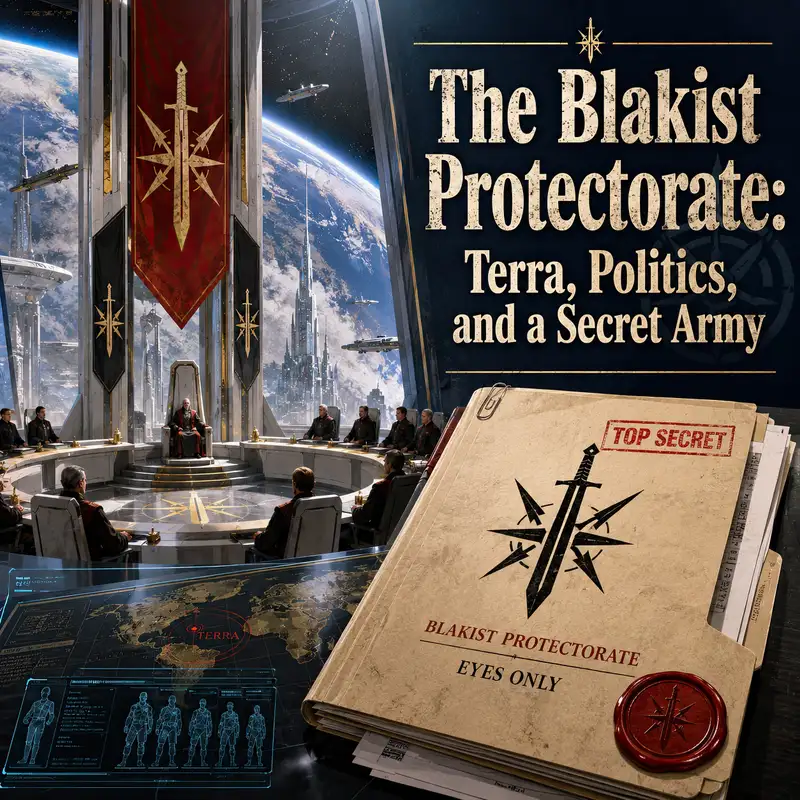
By the time five worlds of the Chaos March asked Terra for protection in February of thirty sixty-six, the Word of Blake had already won the most important part of the campaign. Those worlds believed they were purchasing order, secure communications, and protection from raiders. They were also joining a political system designed to surround Terra with strategic depth, taxable industry, and military bases. The public offer was stability. Behind it stood an army whose full size was concealed not only from foreign intelligence services, but from many members of the Word itself.
That was the central contradiction of the Blakist Protectorate. It did not begin as a line of conquered worlds painted onto a map. It began as a collection of practical arrangements with governments that had good reasons to fear abandonment. The Word repaired hyperpulse generators, signed trade agreements, hunted bandits, reopened factories, and offered troops where no Great House could promise lasting security. At the same time, it was converting Terra into an industrial fortress and building parallel military organizations under competing chains of command.
The Word’s seizure of Terra in thirty fifty-eight made all of this possible. Operation ODYSSEUS combined infiltration, deception, and conventional assault. Blakist sympathizers inside the Terran system helped conceal the approaching force. Soldiers entered under the identity of the Twenty-first Centauri Lancers, a mercenary regiment ComStar believed it had hired. Other forces struck Mars and Venus while commandos moved against elements of the planetary defense network. The operation succeeded because the attackers did not merely penetrate Terra’s defenses. They penetrated the institutions responsible for deciding what counted as a threat.
The conquest was not complete in a single clean stroke. Fighting continued, surviving ComStar personnel resisted, and control of the wider system had to be secured. In thirty sixty-one, the defection of Precentor Klaus Hettig brought the Titan Naval Yards fully into Blakist hands. That gave the Word much more than another flag over another installation. Titan could repair WarShips, support DropShip production, and provide the specialized workforce needed to maintain a navy. A religious exile movement had captured the infrastructure of an interstellar power.
ComStar chose not to launch an immediate reconquest. Anastasius Focht believed the Clans remained the greater strategic danger, and he was correct that a major battle for Terra could consume forces needed along the truce line. The decision was defensible. It was also generous in the way only an unintentional gift can be generous. Every year without a counterattack gave the Word time to restore factories, train recruits, identify loyal officials, and make the occupation appear permanent.
Terra mattered because it was simultaneously a symbol, a headquarters, an industrial center, and a military position. It was humanity’s birth world, the former capital of the Star League, and the spiritual center claimed by both branches of the old ComStar order. Possession of Terra allowed the Word to present itself not as a refugee sect on Gibson, but as the rightful custodian of humanity’s historical center. Political legitimacy in the Inner Sphere often rests on hereditary bloodlines. The Word substituted geography, ritual, and control of the communications network.
The symbolism would have meant little without revenue. The Word operated hyperpulse generator stations across the Free Worlds League and later the Capellan Confederation, earning income while gaining access to commercial and political traffic. Terra supplied taxes, trained labor, research institutions, and factories that ComStar had already begun reactivating after Tukayyid. The Free Worlds League and Capellan Confederation supplied materials and political access. None of this required an impossible secret economy. It required accountants, freight schedules, procurement officers, and several governments that found the arrangement useful.
The military buildup therefore occurred in plain sight, but its meaning did not. Foreign observers knew the Word was purchasing equipment and expanding production. They could see work at Terran factories and naval yards. What they could not determine was how many units existed, where those units were stationed, or which authority controlled them. Public estimates continued to focus on roughly ten divisions. By the opening of the Jihad, later assessments placed the regular Word of Blake Militia at more than forty divisions, with additional formations outside its normal structure.
A division in the Word of Blake Militia was not organized exactly like a Great House regiment. The Word inherited ComStar’s base-six system, combining BattleMechs, vehicles, infantry, battle armor, aerospace assets, and support units in formations that did not fit neatly into conventional intelligence tables. That alone complicated counting. A Level Three could be detached, renamed, or moved without producing the same signature as an entire House regiment. Intelligence officers prefer enemies who use standard organizational charts. The Word had inherited centuries of experience in making organizational charts conceal more than they revealed.
The concealment also relied on mundane techniques. Units used generic white or camouflage schemes, repeated insignia, and moved subformations separately. Training cadres could be counted as instructors rather than combat troops. New equipment could be recorded as replacement stock for existing divisions. Mercenaries provided additional manpower without appearing on the official militia roster. Some formations existed in compartments so restricted that regular Blakist commanders encountered them only when operations began. The secret was not that no evidence existed. The secret was that every piece of evidence had a plausible administrative explanation.
Terra provided the training system to turn matériel into forces. Sandhurst Royal Military College resumed its role as the premier academy for the Blakist militia, with religious indoctrination restored to the curriculum. The War Academy of Mars trained personnel with a strong emphasis on intelligence and command. The Military Academy of Aphros on Venus prepared aerospace and naval personnel. Gibson retained earlier facilities and institutional memory. Factories can produce BattleMechs more quickly than a state can produce competent commanders, technicians, and staff officers. The Word spent years building both.
Its political organization was less orderly. The Word of Blake was governed through a Ruling Conclave representing major internal factions, alongside the Precentor Martial who commanded the regular military. William Blane and the True Believers generally favored unity and eventual accommodation. The Toyama movement pressed a far more militant interpretation of Blake’s mission. Counter-Reformists entertained limited doctrinal revision. Expatriates brought new personnel and new suspicions from secular ComStar. Cameron St. Jamais, as Precentor Martial and leader of the Sixth of June faction, represented an increasingly powerful military current.
These were not minor theological clubs arguing over ceremonial language. Factional affiliation influenced appointments, intelligence access, contracts, and command. ROM monitored the Order for infiltration and disloyalty, while its own leadership participated in factional politics. Military actions formally required authorization from the Conclave except in defense of Blakist holdings or personnel. That exception was large enough to accommodate a remarkable amount of initiative. When an organization controls communications stations across unstable space, almost any intervention can be described as protecting personnel.
The deeper problem was that the Conclave did not control every armed force being created in the Word’s name. A hidden figure known as the Master developed influence beyond the public political structure. The Manei Domini, cybernetically enhanced devotees who regarded themselves as the Master’s chosen instruments, formed the core of the Shadow Divisions. These units answered through Precentor Apollyon rather than the normal chain led by Cameron St. Jamais. The Word was not hiding one army. It was hiding several armies from different audiences, including itself.
The Shadow Divisions should not be confused with the majority of Blakist troops. Most soldiers in the regular militia were not cybernetic zealots operating experimental OmniMechs. They were MechWarriors, vehicle crews, infantry, pilots, technicians, and staff personnel trained within a recognizable military system. That distinction matters. The Word’s power came from conventional institutions capable of sustained operations. The Manei Domini added a force for missions requiring secrecy, speed, and extreme violence. They were the blade kept behind the back, not the entire body holding it.
This divided command structure carried an obvious operational risk. St. Jamais and Apollyon were rivals, and their forces did not share the same culture or priorities. Regular militia officers had to manage theaters, supply lines, garrisons, and allied units. The Shadow Divisions valued decisive strikes and treated ordinary soldiers as inferior. A state can gain flexibility from parallel commands, but it also gains duplicated planning, contested authority, and commanders who may regard coordination as a concession. The Word solved the problem of civilian oversight by creating a military problem instead.
While Terra armed, the Chaos March supplied the political opportunity. The March had emerged from the collapse of Federated Commonwealth authority in the former Sarna region. Local governments faced raids, civil conflicts, mercenary adventurers, neighboring claims, and unreliable communications. For many planetary leaders, sovereignty had become an exercise in choosing which outside power would arrive first. The Word offered a package few rivals could match: hyperpulse service, investment, security forces, diplomatic recognition, and access to Terra.
On Caph, Blakist assistance helped end factional conflict, restore industry, decontaminate damaged areas, and improve transportation. Those projects created employment and visible results. A governor did not need to accept every article of Blakist faith to appreciate functioning rail lines and a reduced chance of being overthrown by next month’s militia commander. Similar agreements elsewhere combined aid with political influence. The Word understood that a repaired factory could produce loyalty more reliably than a sermon, particularly when the sermon arrived with a security detachment.
Not every world joined freely. Bribery, intimidation, manipulated elections, covert agents, and the presence of Blakist troops narrowed the available choices. Control of a hyperpulse generator provided leverage over governments that depended on interstellar messages for trade and defense. A mutual-defense pact could place Blakist officers inside local planning staffs. An agreement to protect a station could become an agreement to protect the city around it, then the continent, then the government. Protectorate was an accurate word, provided one remembered that protection creates a protector.
On February eighteenth, thirty sixty-six, Caph, Keid, New Home, Bryant, and Epsilon Eridani formally banded together under the protection of Terra and the Word of Blake. The new realm appeared small, but its geometry mattered more than its size. These worlds formed the beginning of a buffer around the Terran system and connected the Word to the industrial and political landscape of the Chaos March. Terra was no longer an isolated possession vulnerable to a concentrated reconquest. It was becoming the center of a regional state.
The Protectorate also served a diplomatic purpose. Thomas Marik had nominated the Word for full membership in the Second Star League in thirty sixty-four. A recognized territorial state with a capital, population, military, and treaty network had a stronger claim than a religious organization operating communications stations. The Word wanted admission not merely for prestige. Star League membership could legitimize its possession of Terra, normalize its armed forces, and place Blakist leaders inside the institution that claimed authority over the campaign against the Clans.
Jaime Wolf understood the danger differently. In March of thirty sixty-six, he helped create the Allied Mercenary Command to resist Blakist expansion in the Chaos March. Outreach and Northwind rejected the Word’s growing influence, and clashes followed. Wolf did not need to know the exact size of the hidden army to recognize the pattern. A power centered on Terra was acquiring stations, treaties, clients, and garrisons while the Great Houses were distracted by the Federated Commonwealth Civil War. The map was changing through contracts before it changed through invasion.
The Word answered opposition with its own mixture of politics and covert action. Mercenary commands accepted Blakist employment because contracts, transport, and maintenance still had to be paid for, even when the employer’s theology was unsettling. ROM cultivated sympathizers and applied pressure where diplomacy failed. In thirty sixty-seven, disaffected mercenaries led by Wayne Waco attacked Wolf’s Dragoons on Outreach with Blakist support. The assault failed, but it showed that the struggle over the Protectorate had already moved beyond peaceful competition.
Later intelligence suggested that much of the hidden military buildup had originally been intended for a campaign against the Clans. The best-supported interpretation is that senior Blakist planners expected the Second Star League to survive the thirty sixty-seven conference, admit the Word, and then authorize a major offensive. The Word would reveal its army as the force capable of carrying the war beyond the truce line and perhaps into the Clan Homeworlds. Military victory would restore conquered territory while placing the Word at the center of a renewed Star League.
That plan explains the emphasis on WarShips, advanced troops, cybernetics, and a large industrial reserve. Clan forces held a technological advantage and possessed powerful naval assets, but they also depended on limited population and production bases. Blakist planners appear to have intended a war of overwhelming material, strategic attack, and weapons the Clans could not easily replace. It was a ruthless plan, and some elements likely expected mass destruction on the Clan Homeworlds. It was nevertheless different from an original plan to conquer every Great House.
The distinction does not excuse what followed. It explains why regular officers, technicians, and recruits might participate without believing they were preparing a war against the entire Inner Sphere. They could see themselves as building the army that would finish the work begun at Tukayyid. They could accept secrecy as operational security and the Protectorate as the logistical base for an anti-Clan campaign. Compartmentalization allowed each participant to understand only the portion of the project that made sense from their position.
The Fourth Whitting Conference destroyed that political framework. In November of thirty sixty-seven, the Second Star League dissolved just as the Word expected to secure its place within it. To moderates, this was a diplomatic catastrophe. To militants, it was betrayal. To factions shaped by prophecy, secrecy, and internal surveillance, it appeared to invalidate years of preparation while confirming that the Great Houses could never be trusted. The hidden army still existed. The institution meant to direct it did not.
The first attacks revealed how much had been concealed. Blakist WarShips appeared at Tharkad and New Avalon in December, demanding that the former Federated Commonwealth states return to the Star League. When political pressure failed, the ships opened fire and ground forces followed. Hidden militia divisions emerged across multiple theaters. Shadow Divisions struck high-value targets with methods that shocked even experienced Blakist personnel. The force supposedly built to save the Star League became the instrument used to punish the states that had dissolved it.
Once the Jihad began, the Protectorate expanded rapidly. Communications disruptions associated with the White-Out isolated worlds and confused military responses. Blakist forces occupied systems across the former Terran Hegemony and beyond, sometimes through assault, sometimes through local collaborators, and sometimes by presenting submission as the only alternative to destruction. By thirty seventy-five, the Protectorate controlled more than one hundred forty systems. It had become a fortress belt around Terra and a supply base for campaigns across the Inner Sphere.
The mature Protectorate military developed three principal layers. The regular Word of Blake Militia conducted major operations and provided the professional core. The Shadow Divisions carried out elite strikes under the Master’s separate authority. Beginning in thirty sixty-eight, locally raised Protectorate Militias garrisoned individual worlds. These local formations used more vehicles, infantry, conventional fighters, and older BattleMechs than the first-line units. They were less glamorous, which in military administration often means they were assigned most of the necessary work.
Local militias reduced the demand for expensive high-technology troops and conserved interstellar transport. A planetary force could guard factories, suppress resistance, patrol roads, and delay an invasion without requiring a full regular division to remain in place. At least half of many units came from the local population, while personnel from other Protectorate worlds were mixed in to reduce the chance of mass defection. The arrangement exploited patriotism while limiting local control. It was efficient, suspicious, and entirely consistent with the state that created it.
For civilians, the Protectorate could therefore look very different from one world to another. Some populations saw rebuilt infrastructure, employment, regular HPG service, and protection from raiders. Others experienced occupation, censorship, forced political change, disappearances, and militia recruitment. A local official might cooperate to keep food moving or factories operating without embracing Blakist ideology. Another might use the Word to defeat domestic rivals. Resistance and collaboration were not clean moral categories when a family’s safety depended on which unit controlled the spaceport.
Terra remained the center of the system. Theater commands reported through authorities based there. Industrial output flowed into armies whose existence had once been denied. ROM coordinated intelligence and internal security. Training institutions produced replacements. The Terran defense network was repaired and expanded until a direct assault required defeating WarShips, aerospace forces, orbital installations, ground batteries, and fortified positions. The Protectorate worlds were not merely possessions. They absorbed attacks, supplied matériel, and forced any enemy to fight inward toward Terra.
The system’s greatest strength was also its greatest weakness. Secrecy allowed the Word to mobilize without provoking a unified response. It also prevented honest debate about objectives, force size, and political risk. Compartmentalization protected programs from foreign spies while allowing factions to build capabilities beyond the Conclave’s effective control. When the Star League collapsed, there was no transparent institution capable of reconsidering the plan. There were armed organizations, competing revelations, and leaders who believed delay itself was betrayal.
The Blakist Protectorate was therefore neither an inexplicable empire that appeared overnight nor a simple religious occupation. It was a state assembled from captured infrastructure, communications revenue, Terran industry, vulnerable frontier governments, covert influence, and genuine public works. Its army was not conjured from nowhere. It was recruited, trained, equipped, transported, and hidden through years of ordinary administration conducted under extraordinary secrecy.
Terra gave the Word legitimacy, factories, academies, shipyards, and a defensible center. Politics supplied clients and treaties. The Protectorate supplied taxes, workers, garrisons, and strategic depth. The secret army connected those resources to an ambition the public was never permitted to examine. The Protectorate promised that Terra would protect the worlds around it. In practice, those worlds became the armor around Terra, and the people living on them became the manpower behind a war they had never been allowed to see.